

Commercial lease checklist: what to check first
The day you sign a commercial lease is the day most of your renovation budget gets decided, whether you’ve talked to a contractor or not. Every clause about who pays for restrooms, electrical, storefronts and code upgrades is a construction decision dressed up as legal language. This commercial lease checklist covers the building questions I want every owner to ask before signing, so the space you lease is a space you can afford to open.
I’m Connor Wright, and I run Wright’s Renovations out of Ypsilanti. We walk spaces with business owners across Southeast Michigan before they sign, and the questions below come from those tours. They don’t replace a real estate attorney or broker, but they’ll help you spot the expensive problems early. For the bigger picture on commercial renovation, start there.
Why a commercial lease checklist matters before you sign
Once a lease is signed, your bargaining power drops. Before signing, a landlord may agree to fix a restroom, upgrade an electrical service, contribute a tenant improvement allowance or give you free rent while you build. After signing, those same requests become favors. The building questions on this list are the ones that turn into the biggest checks if you find them late.
It also protects your opening date. A space that needs a change of use, a new restroom or a utility upgrade can take months longer to open than one that doesn’t. Knowing that before you sign lets you negotiate rent start dates that match reality. My post on the commercial build-out timeline explains where those months usually go.
Confirm the use is allowed
Start with zoning. Call the city’s zoning office and ask whether your business is allowed at that address and whether it needs special approval. Ask about parking requirements, sign rules and any limits on hours. Some uses, such as restaurants, fitness studios, child care and cannabis retail, face extra zoning rules in many Southeast Michigan communities.
Then ask the building department whether your business would be a change of occupancy. A change from retail to a restaurant, studio or child care center can trigger new restrooms, exits, fire alarms and accessibility upgrades. My post on change of use in Michigan explains what usually gets triggered and why it matters so much to the budget.
Know what the landlord is delivering
Ask exactly what condition the space will be in on the day you get the keys. Brokers use terms like cold dark shell, warm shell, vanilla shell and second-generation space, and they don’t always mean the same thing to everyone. Get the landlord’s delivery condition in writing, room by room and system by system, with any landlord work given a firm completion date.
A second-generation space that already matches your layout can save a lot. A cold dark shell means you’re paying for nearly everything. My guide to commercial space types in Michigan explains what each type usually includes, and our suite turn service shows what a landlord-ready space can look like.
The building items I check on every tour
When I walk a space with an owner, I look at the same handful of things before anything else. These are the items that most often change a budget:
- The restroom, and whether it meets accessibility rules today
- The electrical service size and how much room is left in the panel
- Where water and drain lines are, and whether the slab can be cut
- The heating and cooling system’s age and who maintains it
- The entrance, storefront glass and whether the door is accessible
Each of those can swing a budget by a lot. Bring a contractor and, if your business is power hungry, an electrician to the tour. Take photos of the panel label, the restroom and the storefront so you can compare spaces side by side later.
Restrooms and accessibility
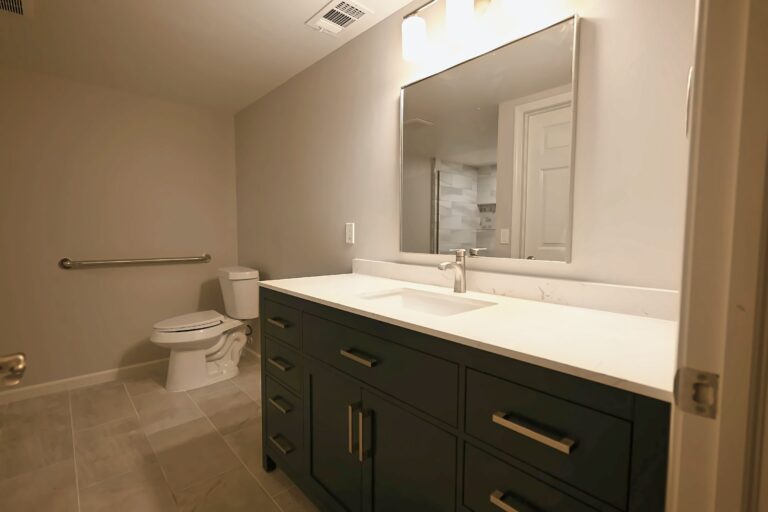
If the space doesn’t have an accessible restroom, plan on building one or negotiating for the landlord to build it. Restrooms are expensive per square foot because they touch plumbing, framing, tile, fixtures and ventilation all at once. Our commercial restroom remodeling page explains what a typical accessible restroom requires.
Accessibility goes beyond the restroom. When you alter an existing space, federal rules often require spending up to 20 percent of the project’s cost on the path of travel to the altered area. Ask who’s responsible for accessibility in the building’s common areas, entrances and parking. Our ADA compliance contractor page explains how that responsibility usually splits, and my post on ADA compliance for small businesses covers a federal tax credit that may help.
Electrical, plumbing and mechanical
Ask for the electrical service size and look at the panel. A salon, café, fitness studio or medical office can easily outgrow a panel sized for a quiet retail store. Upgrades can take time when the utility is involved. If your business needs it, try to get the landlord to deliver the upgrade or fund it through an allowance.
For plumbing, find out where the nearest drain and water lines are. Moving plumbing through a slab means saw cutting, trenching and patching, which adds cost and time. For heating and cooling, ask the system’s age, its capacity and who repairs and replaces it under the lease. A failing rooftop unit can become your problem in year one if the lease says so.
Tenant improvement allowance and work letter
A tenant improvement allowance is money the landlord contributes toward your build-out. It’s negotiated in the lease and often spelled out in a work letter that says what the landlord builds, what you build, who approves drawings and how the allowance gets paid out. Read the work letter closely. Some allowances are paid only after work is done and lien waivers are collected, which means you need to fund the job first.
Bring a line-item budget to that negotiation. Landlords take requests more seriously when they see real numbers. Our tenant improvement contractor page explains how allowances and work letters usually work, and my post on retail build-out costs in Ann Arbor shows how those budgets come together.
Free rent and rent start dates
Ask for rent to start when you can realistically open, not when you get the keys. Many landlords offer a period of free or reduced rent while you build. Tie that period to a realistic construction schedule, including permits, plan review, inspections and any state licensing your business needs.
Ask what happens if permits or approvals are delayed for reasons outside your control. Some leases extend the free rent period or let you exit if the city denies your use. Those protections are worth more than a slightly lower rent number if your project depends on approvals.
Map out your cash, too. Between the security deposit, the first months of rent, the build-out, equipment, inventory and the gap before an allowance gets paid, opening a commercial space takes more money up front than most first-time owners expect. Build a simple monthly cash plan before signing, and if part of the build-out needs to be financed, our financing options page explains what we offer. Knowing the full number keeps the lease from becoming a stretch you regret.
Construction rules in the lease
Most commercial leases include rules for tenant construction. Look for requirements to use landlord-approved contractors, limits on working hours, insurance requirements, approval of drawings, rules for deliveries and dumpsters, and fees for landlord review. These affect your schedule and your cost.
If you plan to renovate while an existing business stays open, check whether the lease allows night and weekend work. My guide on renovating without closing explains how phasing works, and the lease needs to allow it.
Restoration clauses at lease end
Many leases require tenants to remove improvements and return the space to its original condition when the lease ends. That can mean tearing out the restrooms, counters and walls you paid to build. Ask which improvements must be removed and try to get the landlord to agree in writing that standard improvements can stay.
This matters most for specialized spaces such as salons, cafés, studios and medical offices. Our pages on salon build-outs, café build-outs and fitness studio build-outs describe improvements that commonly raise restoration questions.
Neighbors, noise and shared walls
Ask who your neighbors are on every side, above and below. A fitness studio next to a dental office, or a café below apartments, can create noise, odor and vibration complaints that end up in your lap. Check what the lease says about noise and odor and what the landlord expects you to do about them.
Look at the shared walls. Walls that stop at the drop ceiling let sound and air move between suites. Building separating walls to the deck above is a reasonable cost, but it should be in your budget and possibly in the landlord’s work.
Storefront, signage and exterior
Ask what you’re allowed to change on the outside. Signs usually need landlord approval and a city permit, and some downtowns add design review. Storefront glass, entry doors and exterior lighting may be the landlord’s responsibility or yours. Historic districts can limit storefront changes even further.
If the storefront needs repair, find out who pays before you sign. In older downtowns, storefront work often uncovers rot, failed glazing or old trim that needs attention. Our restoration services cover the repair side of that work.
Parking, loading and deliveries
Construction needs a place to park trucks, stage materials and set a dumpster. Your business will need deliveries too. Ask where contractors can park, whether there’s a loading door or dock, and whether the alley or rear lot is shared. In tight downtowns like Ann Arbor’s, those answers can add time and cost to every day of construction.
Customer parking matters for zoning as well as convenience. Some uses require more parking than others, and a city may not approve a restaurant or studio at an address with too few spaces. Ask the zoning office early.
Talk to the previous tenant if you can
The last tenant knows things the listing doesn’t say. Did the roof leak over the back room? Did the heat keep up in January? Did the drains back up? Did the landlord respond to repair calls? If you can reach them, a five-minute conversation can save you a bad surprise.
Look for clues on the tour too. Water stains on ceiling tiles, patched slab, space heaters under desks and extension cords running across the floor all tell a story. We point those out when we walk a space, and we tell you which ones matter for your budget.
Red flags that mean walk away
Some spaces aren’t worth the rent no matter how good the location looks. If zoning won’t allow your use, if the change of use triggers upgrades the budget can’t carry, or if the landlord refuses to put basic delivery conditions in writing, keep looking. The same goes for a lease that makes you responsible for replacing major building systems you didn’t install.
Walking away from a space you love is hard. Signing a lease for a space you can’t afford to open is harder. Our job on a tour is to tell you the truth about what we see, even when it isn’t what you hoped to hear.
Bring a contractor to the tour
A broker knows the market and an attorney knows the lease. A contractor knows what the space will cost to build. Bringing one to the tour, before you sign, is the cheapest insurance you can buy. We walk spaces with owners regularly and tell them what we see, including when a space is a bad fit for the business.
After the tour we can turn what we saw into a written, line-item budget. That budget becomes a negotiating tool with the landlord and a planning tool for your opening. Our process page explains how a walk-through turns into a plan, and our design-build approach explains how we carry it through construction.
Where we tour spaces
We’re based in Ypsilanti and tour commercial spaces across Washtenaw, Wayne, Oakland, Livingston, Monroe and Macomb counties. Most of our walk-throughs happen in Ann Arbor commercial spaces, Ypsilanti storefronts, Saline and Canton. Our Saline office build-out and the Troy title office renovation show how those tours turn into finished spaces.
Questions owners ask before signing
Should I get a contractor’s opinion before signing a commercial lease?
Yes. A contractor can spot restroom, electrical, plumbing and code issues that change your budget, and a line-item estimate strengthens your negotiation with the landlord.
What is a tenant improvement allowance?
It’s money the landlord contributes toward your build-out, negotiated in the lease and usually defined in a work letter that sets out who builds what and how payment works.
What is a restoration clause?
It’s a lease term that may require you to remove your improvements at lease end. Ask which improvements can stay and get it in writing.
Walk the space with us first
An hour with a contractor before you sign can save you a year of regret. Check out our Portfolio to see commercial work we’ve built, or Contact us today to schedule a walk-through.