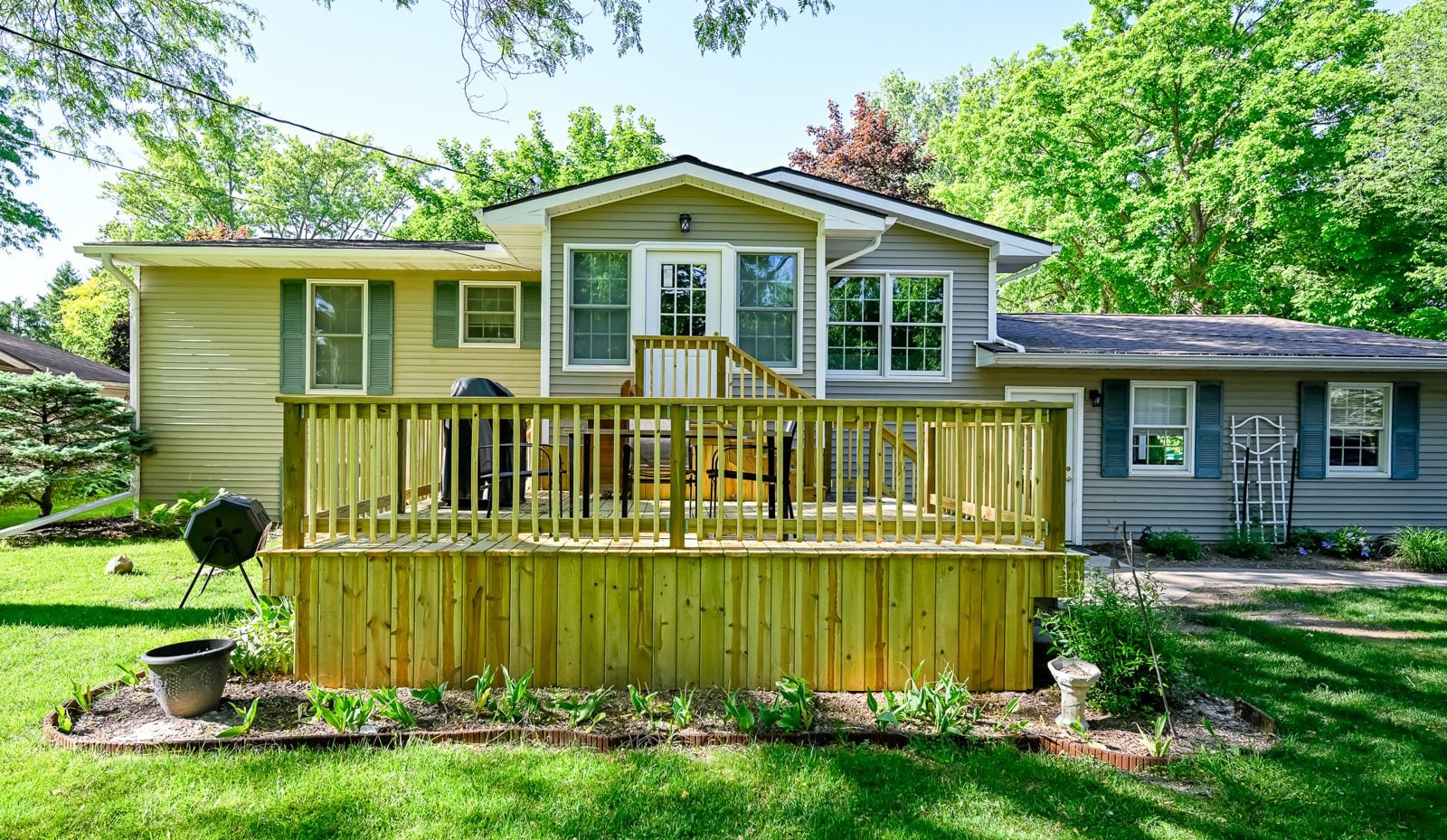
Siding repair and replacement in Southeast Michigan
Most homeowners call about siding repair because of something they can see. A cracked panel. A course that has started to wave. Paint chalking off the south wall. What we find once a panel comes off decides the actual job, and about half the time the visible damage is the smallest part of it.
Wright’s Renovations repairs and replaces siding across Washtenaw, Wayne, Oakland, Macomb, Livingston and Monroe counties. We work on the wall as an assembly rather than a surface, because siding is only the outer layer of a system that also includes the water barrier, the flashing and the sheathing behind it. That system is the subject of our broader exterior home remodeling service.
Telling a repair from a replacement
There is a real answer to this and it is not a judgment call. Repair is the right call when the damage is localized, the wall behind it reads dry, matching material is still available and the rest of the surface has service life left. Replacement is the right call when any one of those four fails.
The one that surprises people is matching material. Vinyl fades, and a new panel in the original color will not match a wall that has been in the sun for fifteen years. On a back wall nobody sees, that is fine. On the front of the house it is not, which sometimes turns a two-panel repair into a one-wall replacement for reasons that have nothing to do with the damage.
Moisture behind the panel is the other threshold. If a probe finds soft sheathing or the moisture meter reads high across more than a small area, patching the outside seals the problem in. We open it, dry it, fix what is wet and rebuild the assembly properly. Smaller, contained fixes that pass all four tests are handled through Wright’s Repairs rather than a full renovation crew.
How each siding material behaves in this climate
Material choice matters less than installation quality and more than color. Freeze and thaw cycles, road salt and high summer humidity all push on these materials differently. If you are early in the decision, the comparison of siding options for Michigan homes goes deeper on each one.
Vinyl
Still the most common material on houses built here after nineteen eighty. It handles moisture well and handles impact badly. Cold makes it brittle, so a stone thrown from a mower in November cracks a panel that would have flexed in July. It also expands and contracts significantly, which means nails driven tight instead of loose cause the buckling and waving you see on hot afternoons.
Fiber cement
Excellent in this climate and the material we specify most often on houses where the budget allows it. It does not rot, does not attract insects and holds paint for a long time. The failure point is the cut ends and the seams: unsealed factory cuts wick water, and a seam without proper flashing behind it will let water into the sheathing. Installation discipline is everything with this product.
Wood and engineered wood
Original cedar and clapboard on prewar houses in Ann Arbor and Ypsilanti can last another few decades with paint and maintenance, and it is usually worth saving on a house with real architectural character. The bottom courses go first, because that is where splash-back and salt live. Engineered wood products handle Michigan better than solid wood but still need the cut edges sealed and the ground clearance respected.
Aluminum and steel
Common on mid-century ranches. Aluminum dents and chalks, steel rusts at the fasteners once the coating is compromised, and both suffer at the lower courses where salt collects. Repair is difficult because matching profiles have mostly been discontinued, so a damaged aluminum wall is usually a replacement conversation.
What is behind the siding matters more than the siding
Every wall we open gets inspected in the same order. Sheathing condition first, because that is the structural layer. Then the water-resistive barrier: on houses built before the mid-eighties there often is not one, or it is felt paper that has torn. Then flashing at every window head, door head, deck ledger and roof-to-wall junction.
Flashing is where the failures concentrate. A window installed without head flashing sends every bit of water that hits the glass straight into the wall below it, and no siding product on the market will stop that. When we are replacing siding on a wall whose openings are also due, we do the openings first, which is why siding and window replacement get quoted together more often than not.
Deck ledgers deserve their own mention. A deck bolted through siding into a rim joist with no flashing is both a water problem and a safety problem, and we find it regularly. That gets corrected as part of the wall work, coordinated with any deck work the house needs.
What siding work costs here
Siding is priced by the square, which is one hundred square feet of wall. The variables that move a quote are all measurable before we start, with one exception.
- Wall area and stories: a two-story wall costs more per square than a one-story wall because of access and staging.
- Material grade: the spread between builder vinyl and painted fiber cement on the same house is generally close to double.
- Trim scope: rebuilding corner boards, window casings and frieze in a matching profile can rival the siding cost on a detailed older house.
- What is behind it: sheathing replacement and framing repair are the one variable nobody can price from the curb.
- Layer count: houses with two existing layers cost more to tear off and dispose of than houses with one.
We quote the known scope firmly and carry the unknown behind-the-wall work as a clearly stated allowance with a unit price, so if we find eight sheets of bad sheathing you already know what eight sheets costs. Paying over time is covered under renovation financing.
The sequence that keeps you from paying twice
Siding goes on after everything that penetrates it. Windows, doors, vents, hose bibs, light fixtures and deck ledgers all get set and flashed first. Then the barrier, then the siding, then trim, then gutters.
Homeowners who re-side first and replace windows two springs later pay for the same trim and flashing work twice, and the new siding gets cut into. If windows are anywhere in your five-year plan, do them with the siding. The same argument applies to an addition or a porch that will tie into the same wall, and it is the reasoning behind our whole complete exterior makeover approach.
The insulation chance you only get once
When the siding comes off, the wall cavity is accessible for the only time in that wall’s life. On houses built before the mid-seventies in this region, that cavity is frequently empty, under-filled or full of settled batt insulation that stopped working decades ago.
Adding exterior continuous insulation or air sealing at that moment costs a fraction of what the same work costs later, because the expensive part is already done: the wall is open. The comfort difference shows up first in the rooms that were always cold, and it shows up on the February gas bill after that. Interior-side work on the same walls is covered under insulation and soundproofing.
There is a trade-off worth knowing about. Adding thickness outside the sheathing changes how windows and doors sit in the wall, so trim depth and jamb extensions have to be planned for. That is a reason to decide about insulation before ordering windows or an exterior door replacement, not after.
Colors, profiles and what the resale market rewards
Two houses on the same street with the same siding budget can land in very different places on curb appeal, and the difference is almost always trim and proportion rather than the color of the field.
What reads as expensive here is consistent reveal, corner boards with real depth, window casings proportioned to the window, and a frieze board where the wall meets the soffit. Builder-grade installations skip most of that and use thin J-channel instead, which is why a fifteen-year-old subdivision wall looks flat even when the material is fine. Rebuilding those details with custom millwork and trim is the highest-return line item on a lot of siding quotes.
On color, the market in Washtenaw and Oakland counties has moved toward deeper, more saturated fields with lighter trim, and away from the beige and taupe palette of the early two thousands. Accent material on gables and entry walls is worth doing where the front elevation can carry it, particularly alongside a screened porch or a rebuilt entry.
How long the work takes and what it is like to live through
A single-wall replacement on a ranch runs a few days. A whole-house tear-off and re-clad with trim on a two-story house runs two to four weeks depending on size, weather and what the walls hide. Repairs are usually same-day or next-day.
You stay in the house the entire time. There is noise during the tear-off, there is a dumpster in the driveway, and there are a few days when a wall is covered in housewrap rather than siding. We close the wall in before every weekend and before any forecast rain, so the house is never left open overnight. Landscaping and deck surfaces get covered before staging goes up, and attached garage walls are sequenced so vehicle access is kept.
The schedule you get is a written week-by-week plan, and you get progress photos rather than having to call and ask. If the plan slips, the note explaining why arrives the same week it happens, not at the end.
Permits, associations and matching what is there
Siding replacement pulls a permit in most Southeast Michigan municipalities. Historic districts in Ann Arbor and Northville add design review, and the review looks at material, profile, exposure and color, which means the decision has to be made before submission rather than after. Homeowner associations in newer subdivisions in Canton, Novi and Northville often restrict color palettes.
We handle the submissions and build the review window into the schedule. The Southeast Michigan permit guide covers what each jurisdiction asks for. On partial replacements, matching the existing profile and exposure is part of our scope, and when the original product is discontinued we will tell you before you commit rather than after the material arrives.
The failures we find most often on Michigan walls
After several hundred exterior projects in this region, the same handful of defects account for most of the rot we open up. None of them are exotic and all of them are preventable at install time.
Missing head flashing over windows and doors is first by a wide margin. Second is siding installed tight to a roof surface or a deck with no clearance, so snow sits against it for three months. Third is caulk used as a substitute for flashing, which works for about five years and then fails silently behind a bead that still looks fine from the ground.
Fourth is bottom courses set too close to grade, where splash-back and salt do their work. Fifth is fasteners driven too tight on vinyl, which causes the buckling homeowners assume is a defective product. When we replace a wall, correcting these is not an upgrade line item, it is the job.
Commercial and multi-building siding work
Siding and panel work on small commercial buildings follows the same physics and a different set of constraints. Tenants stay open, parking has to keep working, and the schedule frequently has to run outside business hours. We plan those projects around occupancy rather than around the crew’s convenience.
Property managers with several buildings usually want a condition assessment across the portfolio before committing to any single one, so the worst wall gets the budget rather than whichever building complained most recently. That work runs through the same estimating process as residential, documented the same way.
When siding damage is an insurance claim
Hail, wind and falling limbs are covered events on most policies, and siding is one of the most commonly claimed exterior components in this region. What is not covered is deterioration, which is why an adjuster who sees a twenty-five-year-old chalked wall with three cracked panels usually declines it.
If a storm caused your damage, document it before anything gets touched and get the claim opened. We work alongside adjusters on storm and disaster repair and we will tell you honestly which parts of a wall are storm damage and which parts are age. Those two answers usually coexist on the same house.
What we check on the walk-through
The siding walk-through takes about an hour and it is free. We take moisture readings at the base of every elevation, probe the trim and sills for soft wood, look at the flashing above every opening, check ground clearance at the bottom course, and pull a downspout to see where roof water is going.
Grade gets checked too, because soil sloping toward the house pushes water at the foundation regardless of what the wall above is made of. When that is the real problem, we say so, and the fix may sit with basement waterproofing or foundation repair before a single panel gets ordered.
You leave that hour with a written scope, a sequence, a range and a plain list of what would change the number. Read about our company and see how we run a job in the Wright’s process.
Getting your siding quoted
Wright’s Renovations works out of 7101 Platt Road in Ypsilanti, Monday through Friday, 8 a.m. to 4 p.m. We take siding work across the region, including Ann Arbor and the rest of Washtenaw County, and we handle commercial exteriors through our commercial division.
Check out our Portfolio for finished exterior work, or contact us today for a free quote. You can also reach us at (734) 540-0347.