
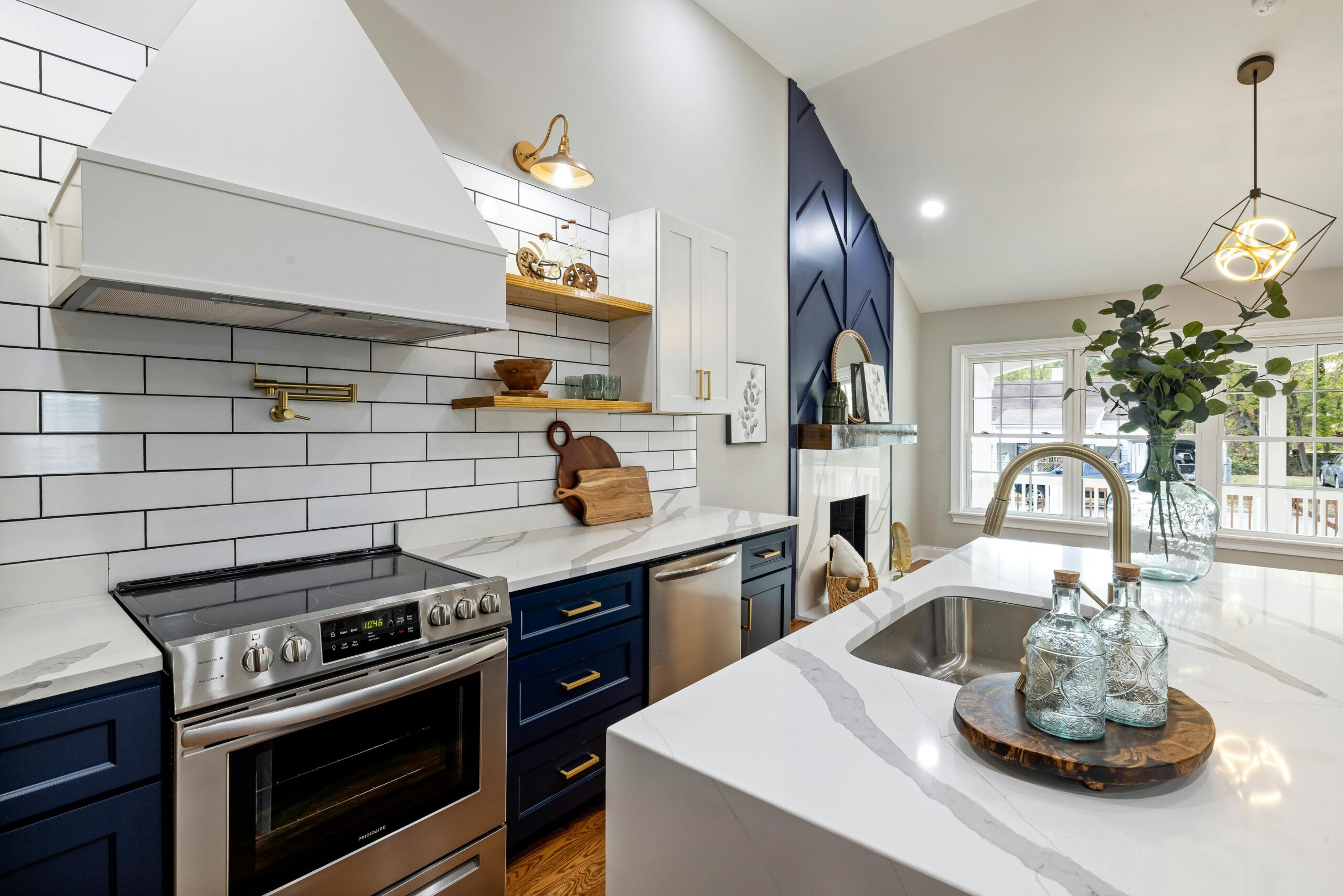
Kitchen island sizing guide: how big should your island be
Table of contents
- Kitchen island size depends on your room, your habits, and your clearance
- Minimum clearances: the non-negotiable numbers
- Sizing the island to your kitchen footprint
- Island height and overhang dimensions
- What to include inside your island
- Island shapes beyond the rectangle
- Common island sizing mistakes
- Working with existing Michigan home layouts
- Countertop materials and how they affect island design
Kitchen island size depends on your room, your habits, and your clearance
A kitchen island is usually the first thing homeowners mention when they call about a kitchen remodel. They want one. They have seen them on every renovation show and in every design magazine. The question I ask before anything else is: how big is your kitchen? Because the island that looks incredible in a 20-by-15 kitchen can make a 12-by-10 kitchen feel like an obstacle course. Sizing an island correctly is the difference between a room that flows and a room that frustrates everyone who walks through it.
I have built islands in kitchens across Ann Arbor, Birmingham, Plymouth, and the rest of our Southeast Michigan service area. Every one was sized to the specific room, the homeowner’s cooking style, and the way their family actually uses the kitchen. This guide covers the dimensions, clearances, and proportions that make an island work in real Michigan homes.
Minimum clearances: the non-negotiable numbers
Before you decide how big your island should be, you need to know how much clear space the room needs around it. These clearances are not suggestions. They are the minimum distances that keep the kitchen functional.
Walkway clearance between the island and any counter, wall, or appliance should be at least 36 inches. That is enough for one person to move comfortably. If two people are working in the kitchen at the same time (and in most Michigan families, they are), 42 to 48 inches is much better. Anything less than 36 inches and you cannot fully open lower cabinets, the dishwasher door hits the island, and people are constantly brushing past each other.
If the island has seating, the overhang side needs 42 inches minimum from the counter edge to any wall or obstruction. That gives someone sitting on a stool enough room to push back and stand up without bumping into anything. For an island with a full eating bar, I prefer 48 inches on the seating side.
Around cooking appliances (cooktop in the island, for example), the National Kitchen and Bath Association recommends 42 inches of clearance on all working sides. If you are placing a cooktop in the island, that clearance is not just about comfort. It is about safety. A person moving through a tight gap next to an active burner is a burn risk.
Sizing the island to your kitchen footprint
Here is the framework I use with clients. It is not a formula. It is a set of proportions that I have seen work consistently across different kitchen sizes.
Small kitchens (under 120 square feet)
In a kitchen under 120 square feet, a traditional island usually does not fit without violating clearances. The room might be 10 by 12 or 11 by 10. With base cabinets on two or three walls already taking 24 to 25 inches of depth, the remaining floor space does not leave enough room for an island plus 36-inch clearances on all sides.
The alternative is a narrow island (18 to 24 inches deep) that functions as a prep surface rather than a full workstation. Or a mobile island on casters that can be moved out of the way when the kitchen needs open floor space. I have done a few of these in older Ypsilanti homes where the homeowner wanted island functionality without the permanence. It works well when the priority is prep space rather than seating.
Medium kitchens (120 to 200 square feet)
This is where most of our projects land. A kitchen that is 12 by 14 or 13 by 15 can typically accommodate an island of 4 feet by 2.5 feet up to about 6 feet by 3 feet, depending on the configuration. The key constraint is the distance from the island to the perimeter counters.
A 4-by-2.5-foot island in a 12-by-14 kitchen provides a solid prep surface with room underneath for storage. It does not try to do everything. No cooktop, no sink, just a butcher block or stone surface with pull-out drawers or shelves below. This is the kind of island that works in the 1960s and 1970s ranches that fill neighborhoods across Livonia, Canton, and Novi.
A 6-by-3-foot island in a 13-by-15 kitchen is large enough for two stools on one end and a prep area on the other. It can support a prep sink if the plumbing run is feasible. This size starts to feel like a real command center for cooking, which is what most homeowners picture when they say “island.”
Large kitchens (over 200 square feet)
In kitchens over 200 square feet, the island can be 7 to 10 feet long and 3.5 to 4 feet deep. Homes in Birmingham, Northville, and parts of Oakland County frequently have open-concept kitchens where the island is the primary work surface and the social anchor of the room.
At this scale, the island often includes a cooktop or a full sink, a dishwasher, a microwave drawer, and seating for three to four. The countertop might be a single slab of quartz or quartzite, which looks spectacular at eight or nine feet of uninterrupted surface. These islands need careful planning for electrical (its own 20-amp circuit for each built-in appliance), plumbing (drain lines and vent stacks for sinks), and pendant lighting placement.
Island height and overhang dimensions
Standard kitchen counter height is 36 inches. Most islands match that height for a consistent work surface. If you are adding a raised bar for seating, the bar section is typically 42 inches high, which accommodates standard counter-height stools (24-inch seat height). A bar-height section at 42 inches with 30-inch stools is the other common setup.
Overhang for seating should be 12 to 15 inches. That gives someone sitting at the island enough knee room without making the overhang so deep it feels unsupported. For overhangs beyond 12 inches on a stone countertop, structural support is required. Corbels, steel brackets, or a knee wall provide that support. I always specify steel L-brackets hidden beneath the countertop on our builds because they are stronger and less visible than corbels.
If the island is purely a work surface (no seating), the countertop can be flush with the cabinet box on all sides, with just a 1-inch overhang for a clean drip edge. This maximizes storage below and simplifies the cabinet design.

What to include inside your island
The interior layout of an island depends on what you need it to do. Here are the configurations I build most often.
Storage-focused islands have deep drawers on both long sides, with pull-out shelves and dividers for pots, pans, baking sheets, and mixing bowls. A built-in trash pull-out (two bins: trash and recycling) is practically standard on every island we build. It eliminates the standalone kitchen trash can entirely.
Appliance-ready islands include a microwave drawer (a built-in microwave that opens like a drawer instead of a door), a warming drawer for entertaining, or an under-counter beverage refrigerator. Each of these requires its own separate circuit, which is why electrical planning during the design phase matters so much.
Sink islands are popular but require careful plumbing. The drain line and vent stack must route from the island through the floor to the basement or crawlspace. In a slab-on-grade home (rare in Michigan but not unheard of), the drain line requires cutting through the slab, which adds significant cost. In a home with a basement, the run is usually uncomplicated but should be planned during the design stage, not improvised during construction.
Island shapes beyond the rectangle
A standard rectangular island works in most kitchens, but it is not the only option. L-shaped islands wrap around a corner and create a larger work surface with a defined cooking zone on one leg and seating on the other. T-shaped islands add a perpendicular dining table extension. Curved islands soften the visual lines of a kitchen and improve traffic flow in open-concept spaces.
In a recent Ann Arbor kitchen project, we built an L-shaped island that gave the homeowner a 12-foot run of counter space on the main leg and a four-foot seating extension on the short leg. The L-shape directed foot traffic around the cooking zone instead of through it, which is exactly the kind of functional detail that makes an island feel right versus feeling like it is in the way.
For homes in Wayne County ranch neighborhoods, the T-shape often solves the problem of a kitchen that opens to a long living room, giving definition to the cooking space without adding a wall.
The shape of your island should respond to the shape of your kitchen, the location of doorways, and how people move through the room. This is something we work out during the design phase, not on the job site.
Common island sizing mistakes
The biggest mistake is making the island too big for the room. I see it in homes where someone measured the island they liked online without measuring their own kitchen. An eight-foot island in a 12-by-14 kitchen creates 30-inch aisles on both sides. That is below minimum clearance and makes the kitchen feel cramped regardless of how beautiful the island itself is.
The second mistake is centering the island in the room without accounting for appliance doors. Your dishwasher, oven, and refrigerator all have doors that swing open. If the island is positioned so that an open dishwasher door blocks the aisle, the island is either too close or too centered. We mock up the island position with blue tape on the floor before committing to the layout, and we have clients physically walk the paths, open the appliance doors, and stand at the stove to confirm everything fits.
The third mistake is under-planning the electrical. An island without outlets is a missed opportunity. Code requires at least one outlet for every four linear feet of countertop. Beyond code, you want outlets where you will actually use small appliances: the stand mixer, the food processor, charging your phone while cooking. Pop-up outlets in the countertop keep the island clean when not in use.
Working with existing Michigan home layouts
Many of the kitchens we remodel across Southeast Michigan were built as galley or U-shape layouts with no island. Adding an island means restructuring the room, and in many cases, removing a wall to create the open floor plan that an island needs to breathe.
If the wall between the kitchen and dining room or living room is non-load-bearing, removal is relatively simple and affordable ($1,000 to $3,000). If it is load-bearing, we install a structural beam or header to carry the load, which runs $3,000 to $8,000 depending on span and accessibility. That cost is worth it. The open layout plus island combination is consistently the highest-value change we make in kitchens across Canton, Plymouth, and Livonia.
My post on kitchen remodel ROI in Michigan covers how this type of layout change affects home value. The short version: open-concept kitchens with islands consistently appraise higher than closed-off kitchens in our market.
Countertop materials and how they affect island design
The countertop material you choose influences the structural requirements of your island. A quartz or granite slab weighs 20 to 30 pounds per square foot. On a 6-by-3-foot island, that is 360 to 540 pounds of stone sitting on the cabinet box. The base cabinets need to be built to support that weight, with plywood construction (not particleboard) and properly shimmed on the subfloor.
For overhangs longer than 12 inches, stone fabricators require support brackets or corbels to prevent cracking at the overhang point. I prefer hidden steel brackets because they do not interrupt the clean lines of the island profile. These get installed during the cabinet phase, before the countertop fabricator arrives to template.
Butcher block islands are lighter and more forgiving structurally but require more maintenance. They can be beautiful as a secondary surface (for example, a butcher block top on a narrow prep island next to a main island with stone). In homes across Northville and Rochester Hills, I have seen dual-island kitchens where one island is the main work surface with quartz and the other is a prep station with butcher block. That configuration works in kitchens over 250 square feet where the floor space can accommodate two islands with proper clearances.
Waterfall edges, where the countertop material continues down the sides of the island to the floor, add visual weight and a modern aesthetic. They also add cost. A waterfall edge on both ends of a quartz island adds $2,000 to $5,000 to the countertop fabrication. It is a design decision, not a functional one, but it can make a standard rectangular island look like a sculptural centerpiece in an open-concept space.
Related reading
For more on kitchen planning, check out our guides on comparing kitchen countertop materials and kitchen remodel ROI.
Explore our services
See our full kitchen island design and build services, our approach to complete kitchen renovations, and our custom cabinet work across Southeast Michigan.
Contact us to talk about your kitchen or check out our portfolio to see our island builds.
