
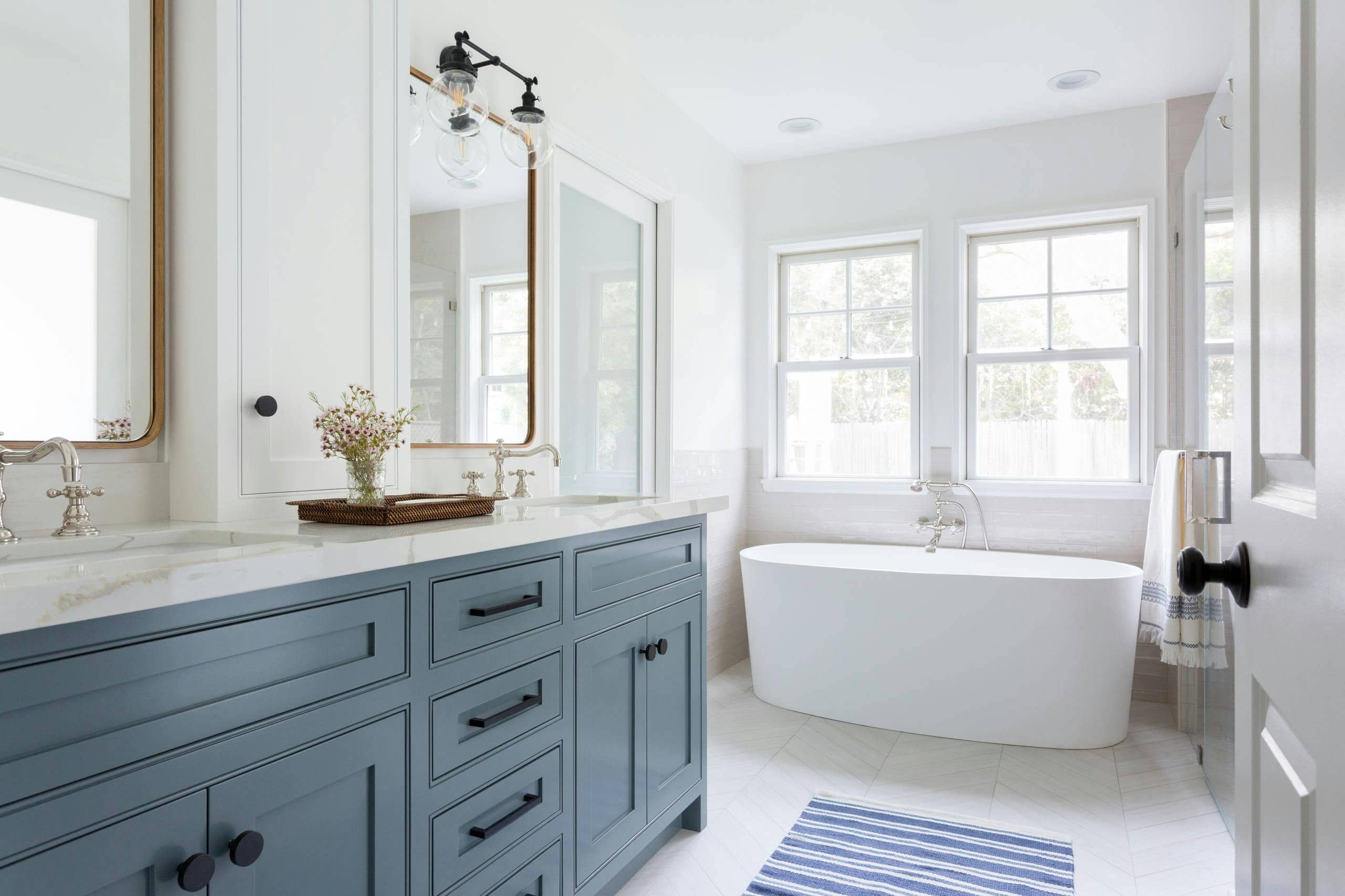
Walk-in shower vs. bathtub: which is right for your Michigan bathroom
Table of contents
- Walk-in shower vs. bathtub: making the right call for your bathroom
- The case for a walk-in shower
- The case for keeping a bathtub
- The hybrid approach: shower and tub in the same bathroom
- Resale value: what Southeast Michigan buyers expect
- Accessibility and aging-in-place factors
- Curbless shower design: the premium walk-in option
- Glass enclosure options and their impact on the budget
- Making the decision with Wright’s Renovations
Walk-in shower vs. bathtub: making the right call for your bathroom
The walk-in shower vs. bathtub decision defines everything else in a bathroom remodel. It determines the layout, the plumbing rough-in, the tile scope, the glass enclosure (or lack of it), and in many cases whether the project stays at $15,000 or climbs past $30,000. I have built hundreds of bathrooms across Southeast Michigan with both configurations, and the answer is never universal. It depends on the bathroom’s size, who uses it, whether it is the only full bath in the house, and what the local real estate market expects when you sell.
This is not a trend article. Trends shift every three years. This is the practical breakdown I give clients in Ann Arbor, Birmingham, and Plymouth before they commit to a configuration they will live with for the next decade.
The case for a walk-in shower
Walk-in showers have become the dominant choice in primary bathroom remodels across our service area. The reasons are practical, not just aesthetic. A walk-in shower eliminates the step-over barrier of a tub, which matters for aging homeowners and anyone with mobility considerations. It opens up floor space in bathrooms where every square foot counts. And it gives the tile installer a canvas for the kind of material work that transforms a bathroom from functional to exceptional.
Walk-in shower costs in Michigan
A walk-in shower installed in our Southeast Michigan projects runs $4,500 to $15,000 depending on size, tile selection, glass enclosure type, and fixture quality. A basic 36-by-48-inch shower with porcelain tile, a frameless glass panel, and a standard showerhead lands around $5,000 to $7,000. A large curbless shower with natural stone tile, a linear drain, body jets, and a full frameless glass enclosure pushes $10,000 to $15,000. The bathroom remodel cost guide breaks down how the shower configuration affects total project pricing.
The shower pan is the critical cost variable most homeowners overlook. A pre-formed acrylic pan ($200 to $500) keeps costs low but limits the shower to standard dimensions. A custom mud-set pan with waterproof membrane ($800 to $1,500 for materials and labor) allows any size or shape, enables curbless entry, and accommodates linear drains. For a premium shower installation, the custom pan is worth the investment because it eliminates the constraints that force design compromises later.
Walk-in shower design considerations for Michigan homes
Older Michigan homes frequently have bathrooms built around a standard 5-foot tub alcove. Converting that alcove to a walk-in shower uses the same footprint but requires reworking the plumbing rough-in, adjusting the drain location, and waterproofing surfaces that were previously covered by the tub. The conversion is routine work for an experienced crew, but the scope is larger than homeowners expect when they picture simply removing a tub and tiling the walls.
Ventilation matters more in a walk-in shower than in a tub bath because the open design allows more steam to escape into the room. Michigan bathrooms already fight humidity issues (condensation on windows in winter, mold risk in poorly ventilated spaces), and a shower that produces more ambient moisture needs a fan rated for the room volume. We specify bathroom exhaust fans at 1.0 CFM per square foot minimum for bathrooms with walk-in showers, compared to the 0.8 CFM standard for tub-only bathrooms.
The case for keeping a bathtub
Bathtubs serve purposes that showers cannot replace. Young children need baths. Adults who value soaking for relaxation or pain relief need a tub. And the real estate market in many Southeast Michigan neighborhoods still expects at least one bathtub in a home with three or more bedrooms. Removing every tub from a house narrows the buyer pool in ways that can cost more at resale than the bathroom remodel saved.
Bathtub costs in Michigan
A standard 60-inch alcove tub (the type most Michigan homes have) costs $300 to $800 for the unit. Installed with new plumbing trim, a tile surround, and updated drain hardware, the total runs $2,500 to $5,000. A freestanding soaking tub adds visual drama and costs $1,200 to $5,000 for the tub itself, plus $1,500 to $3,000 for plumbing and installation. Freestanding tubs require floor reinforcement in some older homes because a cast iron tub filled with water and an adult weighs over 600 pounds. Our crews verify joist capacity before committing to a freestanding tub location in any home built before 1970.
Japanese-style deep soaking tubs, air-jet tubs, and whirlpool tubs sit at the premium end. A quality air-jet tub installed runs $4,000 to $8,000. These units require their own electrical circuits, GFCI protection, and access panels for motor maintenance. The ongoing maintenance question is important: whirlpool jets need periodic cleaning to prevent biofilm buildup in the plumbing lines, and air-jet systems need the air channels dried after each use. I recommend air jets over whirlpool jets because the maintenance is simpler and the risk of mold in the jet lines is lower.
When the tub should stay
Keep a bathtub in the house if you have children under age eight who need baths regularly, if the bathroom is the only full bath (removing the only tub in a Northville or Novi home with three bedrooms will cost you at resale), or if you or someone in the household uses the tub for therapeutic soaking. The question is not whether tubs are popular. The question is whether your household needs one and whether your home’s floor plan requires one for resale positioning.
The hybrid approach: shower and tub in the same bathroom
In primary bathrooms with enough square footage (typically 70 square feet or more), installing both a separate walk-in shower and a freestanding tub gives you the best of both options. This is the configuration we build most often in the Oakland County premium market, where primary bathrooms frequently exceed 100 square feet and the budget supports both fixtures.
The layout requires thoughtful plumbing planning. The shower and tub need separate drain lines, the tub filler needs its own supply lines (often a floor-mounted filler for freestanding tubs), and the wet zone of the shower needs spatial separation from the tub to prevent water splash issues. A good layout places the shower on one wall and the freestanding tub on the opposite wall or in a corner, with the vanity area between them. This creates three distinct zones within the bathroom: wet (shower), soak (tub), and prep (vanity and mirror).
Cost for the hybrid configuration typically adds $3,000 to $6,000 over a shower-only remodel, depending on the tub selected. A quality freestanding acrylic tub at $1,500 plus plumbing at $2,000 is the minimum. The visual payoff in a properly designed bathroom is significant, and in homes priced above $500,000 across Washtenaw County, the hybrid primary bathroom is becoming the expected standard rather than a luxury upgrade.

Resale value: what Southeast Michigan buyers expect
Real estate data for our service area tells a clear story. In homes with two or more full bathrooms, converting the primary bath to a walk-in shower has no measurable negative impact on resale value as long as at least one other bathroom retains a tub. Buyers in the Ann Arbor market and Birmingham neighborhoods consistently prefer an updated walk-in shower over a dated tub surround in the primary bathroom.
In homes with only one full bathroom, removing the tub reduces the buyer pool. Families with young children will pass on a one-bath home with no tub. Appraisers in some Southeast Michigan municipalities count a “full bath” as having both a shower and a tub, and a bath with only a shower may be categorized as a three-quarter bath. That reclassification can affect the comp analysis and, by extension, the appraised value. If you are removing the only tub, understand the appraisal implications before committing.
Accessibility and aging-in-place factors
Michigan’s population is aging, and bathroom accessibility is the fastest-growing request in our remodel consultations. A curbless walk-in shower with a built-in bench, grab bars, and a handheld showerhead allows a homeowner to use the bathroom safely through their seventies and beyond. The accessible bathroom remodel page covers the specific fixtures and design standards (ADA-adjacent residential guidelines) we follow for aging-in-place projects.
A bathtub, by contrast, becomes harder to use safely as mobility decreases. The step-over height for a standard alcove tub is 14 to 16 inches. Walk-in tubs with a door address this, but they are expensive ($3,000 to $8,000 for the unit), slow to fill and drain, and require the bather to sit inside the tub while it fills, which is uncomfortable in winter. For clients planning to stay in their Wayne County or Livingston County home long term, I recommend the curbless shower over a walk-in tub in almost every scenario because the shower is more practical, more dignified, and less expensive to maintain.
Curbless shower design: the premium walk-in option
A curbless shower eliminates the raised threshold at the shower entry, creating a flush transition from the bathroom floor into the shower. The entire bathroom floor slopes gently toward the shower drain, which means water containment depends on the slope and the glass enclosure rather than a physical barrier. This design is the gold standard for accessible bathroom renovations because wheelchair users and anyone with mobility limitations can roll or walk directly into the shower without navigating a curb.
Curbless showers cost $1,500 to $3,000 more than curbed walk-in showers because the floor construction is more complex. The entire bathroom floor must slope toward the drain, which requires a mud-set substrate or a pre-formed shower tray that extends beyond the glass enclosure. The waterproofing membrane must cover the full bathroom floor, not just the shower area. And the glass enclosure must be precisely fitted to contain splash without relying on a curb for the bottom seal. Our crews build curbless showers regularly in the Novi area and across the broader Oakland County market, and the result is a bathroom that feels like a high-end spa.
The linear drain has become the preferred drainage solution for curbless showers. Positioned along one wall (usually the back wall or the threshold line), a linear drain collects water across its full length, allowing the floor to slope in one direction rather than four. This single-direction slope is easier to tile accurately with large-format tile and creates a cleaner visual. Linear drains run $300 to $800 for the drain hardware and add $400 to $800 in installation labor over a standard center drain.
Glass enclosure options and their impact on the budget
The glass enclosure is the most visible element of a walk-in shower and one of the largest cost variables. A single fixed glass panel (the most popular option in our projects) costs $800 to $1,500 installed. A full frameless enclosure with a hinged door runs $1,500 to $3,500. A semi-frameless sliding door sits between those ranges at $1,000 to $2,200. The glass thickness (3/8 inch standard versus 1/2 inch premium) affects both the cost and the feel of the enclosure. Half-inch glass feels substantial when you push the door open, and the extra weight means smoother hinge operation and better seal performance over time.
For bathrooms in Canton and Livonia where the budget needs to stay disciplined, a single fixed panel with a 12-inch open entry provides the walk-in experience without the cost of a full enclosure. The panel blocks the majority of water spray from reaching the bathroom floor while leaving an open entry that eliminates the need for a door. This configuration works best in showers 48 inches wide or larger, where the panel covers the showerhead side and the open entry is on the opposite side, away from the direct water path.
Hardware finishes on glass enclosures should match the other bathroom fixtures. Brushed nickel panels with chrome faucets create a visible mismatch. Our team coordinates the glass hardware finish with the shower valve trim, towel bars, and vanity hardware during the design phase. This coordination takes five minutes during the fixture selection meeting and prevents a mismatched bathroom that would require replacing hardware later. In homes across the Southeast Michigan service area, brushed gold and matte black have replaced chrome as the most popular glass hardware finishes over the past three years.
Making the decision with Wright’s Renovations
Every bathroom remodel consultation starts with measuring the room and discussing who uses it. The shower vs. tub decision flows from those two facts. We bring fixture catalogs, tile samples, and glass enclosure options to the consultation so you can see the materials at actual scale. A 36-inch shower panel looks different in a catalog than it does held up in a 5-foot alcove.
If you are unsure which direction to go, we can sketch both configurations during the consultation and provide pricing for each so the comparison is concrete. There is no commitment until you approve the design. Schedule a consultation to compare options for your bathroom. We work with homeowners across Washtenaw, Oakland, and Wayne counties, and the shower-vs-tub conversation is where most bathroom projects begin. We can also discuss combining both options in a single room if the space supports it, which many primary bathrooms in newer Southeast Michigan homes do. The consultation includes rough pricing for each configuration so you leave with concrete numbers, not abstract concepts. Check our client reviews to see both configurations in completed Michigan bathrooms.
