
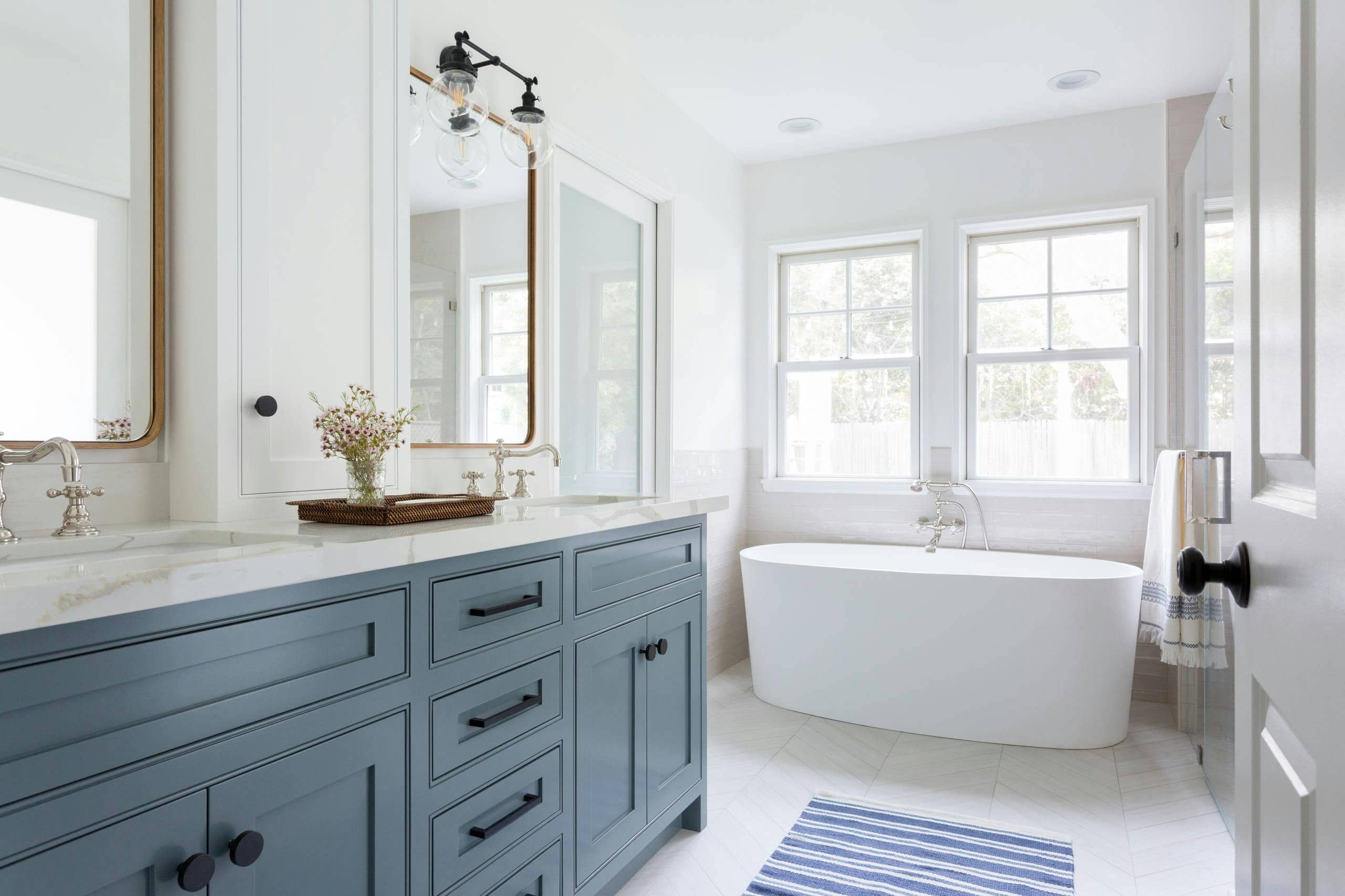
Bathroom vanity types: how to choose the right vanity for your remodel
Table of contents
- Choosing a bathroom vanity that works for your space and your routine
- Freestanding vanities: the most common choice
- Floating vanities: the modern option that opens floor space
- Furniture-style vanities: character and warmth in traditional bathrooms
- Custom vanities: built to solve specific problems
- Countertop and sink combinations for bathroom vanities
- Sizing your vanity for the room and the household
- Vanity storage accessories that maximize function
- Mirror and medicine cabinet integration with your vanity
- Working with Wright’s Renovations on vanity selection
Choosing a bathroom vanity that works for your space and your routine
Bathroom vanity types range from basic builder-grade boxes to custom furniture pieces that define the room’s character. The vanity is the most-used element in any bathroom, touched multiple times daily for hand washing, grooming, and storage access. It is also the visual anchor that sets the design tone for the tile, lighting, and fixtures around it. I have installed every vanity configuration available in bathrooms across Ann Arbor, Birmingham, and Southeast Michigan, and the right choice depends on the room’s dimensions, the household’s storage needs, and the design direction that the homeowner wants the bathroom to take.
Freestanding vanities: the most common choice
Freestanding vanities sit on the floor and attach to the wall for stability. They range from 18-inch single-sink powder room units to 72-inch double-sink pieces for primary bathrooms. The category includes pre-built home center vanities ($300 to $1,500), semi-custom vanities ordered with modified dimensions and finishes ($1,200 to $4,000), and fully custom vanities built to specification ($3,000 to $10,000). The price range reflects the same quality tiers as kitchen cabinetry: construction method, material quality, finish durability, and hardware grade all scale with price.
Pre-built vs. semi-custom freestanding
A pre-built vanity from a home center arrives fully assembled or in a few pieces that connect with cam locks. The finish options are limited (usually white, espresso, gray, and one or two wood tones), the dimensions are fixed at standard increments, and the construction uses particleboard or MDF with laminate or thermofoil surfaces. For a hall bathroom or guest bath that sees light use, a pre-built vanity performs adequately and keeps the bathroom remodel cost in check.
A semi-custom freestanding vanity offers width modifications in 1-inch increments, door style selection from 20 to 50 options, finish choices across 30 or more colors, plywood box construction, soft-close doors and drawers, and interior accessories like pull-out trays and drawer dividers. For the primary bathroom remodel where the vanity is in use daily, the semi-custom tier provides the durability and personalization that a pre-built unit cannot match. Our semi-custom vanity orders in Plymouth and Northville projects typically run $1,800 to $3,500 for a 48-to-60-inch double vanity including the countertop but excluding the sinks and faucets.
Floating vanities: the modern option that opens floor space
A floating (wall-mounted) vanity attaches to the wall with a concealed bracket system, leaving open space between the bottom of the vanity and the floor. The visible floor beneath the vanity makes the bathroom feel larger, simplifies floor cleaning, and creates a visual lightness that grounded vanities do not achieve. Floating vanities are the preferred choice in contemporary and modern bathroom designs across the Oakland County communities and the broader Southeast Michigan market.
Floating vanity installation requirements
A floating vanity must be secured to wall studs or a structural blocking board that can support the weight of the vanity, the countertop, the sink, and a person leaning on it (combined load of 200 to 300 pounds for a 48-inch vanity). During a remodel, our crew installs a horizontal blocking board (2-by-10 or 2-by-12 dimensional lumber) between the wall studs at the mounting height before closing the wall with drywall. This blocking is invisible in the finished room but provides a continuous mounting surface that distributes the vanity weight across multiple studs.
Retrofitting a floating vanity onto an existing wall without exposed framing is possible but requires locating the studs precisely and using heavy-duty lag bolts. If the studs do not align with the vanity’s mounting bracket positions, the installer must open the wall to add blocking, which increases labor cost by $200 to $400. Planning for a floating vanity before the drywall goes up eliminates this issue entirely. The plumbing rough-in also differs from a freestanding vanity because the supply and drain lines exit the wall rather than the floor, which requires adjusting the plumbing during the rough phase.
Floating vanity costs in Michigan
Floating vanities typically cost 10 to 25 percent more than equivalent freestanding vanities because the wall-mount hardware, the structural backing requirement, and the modified plumbing rough-in add cost. A 48-inch floating vanity with a quartz countertop, an undermount sink, and installation runs $2,500 to $5,000 in our projects. The aesthetic premium is worth it in bathrooms where the modern, airy look is central to the design intent.
Furniture-style vanities: character and warmth in traditional bathrooms
A furniture-style vanity looks like a freestanding piece of furniture that happens to have a sink in it. Turned legs, decorative aprons, open bottom shelves, and period-appropriate hardware give these vanities a collected, antique feel that suits traditional and farmhouse bathroom designs. In the historic homes of the Ann Arbor area and Ypsilanti neighborhoods, a furniture-style vanity complements the existing architectural character in ways that a modern floating unit would contradict.
The open bottom of many furniture-style vanities exposes the plumbing. The drain, supply lines, and shut-off valves are visible, which means the plumbing must be presentable. Chrome or brass exposed plumbing with decorative escutcheons looks intentional. PVC drain pipe and plain copper supply lines look unfinished. Our plumbers install decorative P-traps and supply line covers when a furniture-style vanity leaves the plumbing exposed, adding $150 to $300 to the plumbing finish cost.
Furniture-style vanities range from $800 to $4,000 depending on construction quality and the manufacturer. Many are constructed from solid hardwood, which provides structural durability but requires a sealed finish that prevents water damage. A poorly finished furniture vanity in a full bathroom will show water rings and finish degradation within two years. The finish must be a marine-grade or catalyzed lacquer that seals the wood against the humidity and splash inherent in a bathroom environment.
Custom vanities: built to solve specific problems
Custom vanities are built by a cabinet maker to your exact specifications. The construction, material, finish, and dimensions are all determined by the homeowner and the designer rather than selected from a catalog. Custom vanities solve problems that stock and semi-custom units cannot address: non-standard room dimensions, unusual plumbing locations, integrated appliances (like a built-in hamper or a hair tool organizer with electrical outlet), and specific wood species or finish requirements.
Custom bathroom vanities in our projects run $4,000 to $10,000 depending on size, material, and complexity. A 72-inch double vanity in rift-cut white oak with integrated drawer electrical outlets, a built-in hamper compartment, and a catalyzed matte finish represents the high end. A 36-inch single vanity in painted maple with standard storage represents the entry point for custom. The design-build process at Wright’s Renovations includes custom vanity specification as part of the design phase, with shop drawings reviewed and approved before fabrication begins.

Countertop and sink combinations for bathroom vanities
The vanity countertop and sink are ordered as a system. The three most common configurations are an undermount sink with a stone or quartz countertop, a vessel sink sitting on top of the counter, and an integrated sink where the basin and counter are one continuous piece (common in solid surface and concrete vanity tops).
Undermount sinks with quartz countertops are the most popular combination in our projects because they are easy to clean (no rim to trap dirt), durable, and available in a wide range of bowl shapes and sizes. The countertop overhangs the sink bowl, and the junction between the two is sealed with silicone. Countertop cost for a 48-inch vanity top in quartz runs $400 to $800 fabricated and installed. Natural stone (marble, granite, quartzite) runs $600 to $1,200 for the same size. The countertop materials comparison covers the performance differences between these materials in detail.
Vessel sinks (bowls that sit on top of the counter) add visual height and create a statement piece, but they require a taller faucet (wall-mounted or deck-mounted vessel filler) and raise the effective basin height by 4 to 6 inches above the counter. On a 36-inch-tall vanity, a vessel sink puts the basin rim at 40 to 42 inches, which may be uncomfortably high for shorter users. Vessel sinks work best on vanities at 30 to 32 inches tall, where the raised basin brings the working height to a comfortable 34 to 38 inches.
Sizing your vanity for the room and the household
Vanity width must account for the sink, the counter space on each side, and the storage below. A single-sink vanity should be at least 24 inches wide (18 inches for a powder room where counter space is less important). A double-sink vanity should be at least 60 inches wide to provide adequate basin spacing and shared counter between the sinks.
Vanity depth (front to back) typically measures 20 to 22 inches for standard vanities and 16 to 18 inches for shallow or narrow vanities designed for tight bathrooms. Reducing depth from 22 to 18 inches saves 4 inches of floor space, which can make the difference between a bathroom that feels cramped and one that feels comfortable. In Canton and Livonia homes with smaller secondary bathrooms (40 to 50 square feet), a shallow vanity with a compact undermount sink provides full functionality without dominating the room.
The clearance between the vanity and the opposite wall or fixture matters for daily comfort. Building codes require a minimum of 21 inches of clear floor space in front of a vanity. Comfortable clearance is 30 inches or more. If the toilet sits across from the vanity, the clearance between the vanity face and the front of the toilet bowl should be at least 24 inches for comfortable movement between the two fixtures.
Vanity storage accessories that maximize function
The interior organization of a vanity determines whether the cabinet space serves you or frustrates you. A 48-inch vanity with fixed shelves and no interior accessories wastes 30 to 40 percent of the usable volume because items stack on top of each other and smaller items disappear behind larger ones. Drawer dividers, pull-out trays, and interior organizers convert that wasted space into accessible storage.
Drawer vanities (drawers instead of doors on the base cabinets) provide the most accessible storage because items are visible from above when the drawer opens. A wide bottom drawer holds hair tools, bulky product bottles, and cleaning supplies. A narrow top drawer holds cosmetics, razors, and small daily-use items. The drawer configuration mirrors the storage approach used in high-end kitchen cabinet design, where drawers have replaced doors as the preferred base cabinet format because of the superior access they provide.
Electrical outlets inside vanity drawers ($100 to $200 per outlet during construction) power hair dryers, curling irons, and electric toothbrush chargers without visible cords on the countertop. The outlet activates when the drawer opens and deactivates when it closes, preventing energy waste and fire risk from a hot tool left on in a closed drawer. This feature, once limited to luxury bathrooms, has become increasingly common in our mid-range projects across the Plymouth area and Novi because the component cost has decreased while the daily convenience has not changed.
Mirror and medicine cabinet integration with your vanity
The mirror above the vanity should be sized proportionally to the vanity width. A mirror that is narrower than the vanity looks undersized and makes the vanity feel too large. A mirror that matches the vanity width or extends slightly beyond it creates visual balance. For double vanities, two individual mirrors (one above each sink) with a decorative sconce between them create defined zones for each user. A single long mirror spanning the full vanity width creates a more expansive, open look.
Recessed medicine cabinets with mirrored doors provide concealed storage (medications, small toiletries, razors) while serving as the room’s mirror. The cabinet recesses into the wall cavity between studs, requiring no floor space and minimal wall projection. A 30-by-36-inch recessed medicine cabinet fits between standard 16-inch-on-center studs and provides three to four adjustable shelves of storage. In bathrooms across Macomb County and Livingston County where storage space is limited, a pair of recessed medicine cabinets above a double vanity adds the storage equivalent of a small linen closet without consuming any floor area. The recessed cabinet depth matches the wall cavity, so no part of the cabinet protrudes into the room.
Working with Wright’s Renovations on vanity selection
Vanity selection is part of the bathroom remodel consultation at Wright’s Renovations. We measure the bathroom, assess the plumbing rough-in, discuss the household’s storage and grooming needs, and present vanity options across the quality and price spectrum. The vanity choice drives the plumbing plan, the electrical plan (mirror lighting, outlet placement), and the tile layout, so it needs to be decided early in the design process.
We bring physical vanity door and finish samples alongside tile samples and fixture catalogs so every selection happens in context. A vanity finish that looks warm under showroom lighting may read differently under the bathroom’s existing light or the new light fixtures being specified. Evaluating materials together prevents mismatches that individual shopping trips create.
Schedule a consultation to explore vanity options for your bathroom remodel. We serve homeowners across Washtenaw County, Oakland County, and the Wayne County area. Check our client reviews for examples of vanity installations in finished Michigan bathrooms.
