
Small kitchen remodel ideas that work in Michigan homes
Table of contents
- Small kitchen remodel ideas that actually solve space problems
- Open the wall to borrow visual space
- Maximize vertical storage from floor to ceiling
- Rethink the kitchen triangle in a small footprint
- Cabinet and storage solutions for compact kitchens
- Lighting strategies that make small kitchens feel larger
- Countertop and material choices that expand visual space
- Appliance selection for small kitchens
- Color and material strategies that make 90 square feet feel like 130
- What a small kitchen remodel costs in Southeast Michigan
- Working with Wright’s Renovations on your small kitchen remodel
Small kitchen remodel ideas that actually solve space problems
Small kitchen remodel ideas matter most when the room cannot grow. In Southeast Michigan, thousands of homes built between 1940 and 1975 have kitchens measuring 8 by 10 feet or smaller. These kitchens were designed for a single cook preparing meals from a limited pantry. They were not designed for two working adults cooking dinner together, a homework station on the counter, a coffee bar in the corner, and a recycling center next to the trash. The room did not get smaller. The demands on it grew. Every kitchen remodel I do in a compact space starts with the same question: what does this kitchen need to do that it currently cannot?
This guide focuses on the strategies that produce the biggest functional improvement per dollar in small Michigan kitchens. Not cosmetic updates. Not Pinterest mood boards. Structural and layout changes that make the room work differently.
Open the wall to borrow visual space
The most impactful change in a small kitchen is removing or opening the wall between the kitchen and the adjacent room. You do not add a single square foot of kitchen floor, but the visual space doubles or triples because the eye travels through the opening into the living or dining room. I have done this modification in dozens of Livonia, Canton, and Wayne County ranch homes, and it transforms the kitchen experience more than any cabinet or countertop upgrade.
A half-wall (36 to 42 inches tall) with a countertop overhang creates a breakfast bar that adds prep space and casual seating without fully removing the wall. This approach works well in kitchens where the wall is load-bearing and full removal would require an expensive structural beam. The half-wall retains the structure, and the countertop overhang provides seating for two people. Cost for the half-wall approach with new countertop and finish work runs $3,000 to $6,000, compared to $5,000 to $8,000 for full wall removal with beam installation. The permit requirements in Southeast Michigan apply to both approaches if the wall is structural.
Maximize vertical storage from floor to ceiling
In a small kitchen, horizontal space is fixed by the walls. Vertical space between the top of the upper cabinets and the ceiling is wasted in most Michigan homes. Standard upper cabinets are 30 inches tall, and a typical kitchen ceiling is 96 inches. After accounting for the 18-inch gap between the countertop and the upper cabinets, that leaves 12 to 18 inches of dead space above the cabinets that collects dust, hides forgotten items, and serves no functional purpose.
Extending cabinets to the ceiling reclaims that space for storage. The top shelf stores items used seasonally (holiday dishes, large serving platters, rarely used appliances), and the cabinet face creates a clean, built-in look that makes the room feel taller. In our projects across Ann Arbor and Ypsilanti, ceiling-height cabinets are the single most effective storage upgrade for a small kitchen. The additional cabinet cost runs $1,500 to $3,500 depending on the tier (stock extensions versus semi-custom built to fit), and the storage gain is equivalent to adding a full pantry closet.
Open shelving on one wall is an alternative that costs less and creates visual openness. Floating shelves ($200 to $600 installed per shelf) replace upper cabinets on a small section of wall, breaking up the visual weight of cabinet faces that can make a small kitchen feel like a box. The trade-off is exposed storage: everything on the shelf needs to be presentable. For homeowners who keep minimal, organized kitchenware, open shelving works beautifully. For homeowners with overflowing collections of mismatched mugs and stacked Tupperware, closed cabinets are a better solution.
Rethink the kitchen triangle in a small footprint
The classic work triangle (sink, stove, refrigerator positioned at three points with 4 to 9 feet between each) was designed for larger kitchens. In a small kitchen, the triangle collapses into a line or a tight L. That is not a problem to solve; it is actually an advantage. A compact triangle means fewer steps between tasks, which makes cooking more efficient if the layout is intentional about where each element sits.
In galley kitchens under 100 square feet, I place the sink and stove on the same wall with the refrigerator on the opposite wall. This creates a two-step work flow: pivot from the refrigerator (behind you) to the prep area (in front of you) to the stove (next to the prep area). The sink sits between the prep zone and the stove for easy pot filling and hand washing. Every element is within arm’s reach. The renovation process includes layout optimization during the design phase, and small kitchens benefit the most from this planning step because moving an appliance by even 12 inches can eliminate a daily frustration.
Cabinet and storage solutions for compact kitchens
Interior cabinet accessories recover space that standard shelves waste. A lazy Susan in a corner base cabinet converts the 36-inch dead corner into accessible storage. Pull-out drawers replace fixed shelves in base cabinets, making items at the back visible and reachable without kneeling and reaching blindly. A pull-out trash and recycling bin built into a base cabinet eliminates the floor-standing trash can that consumes 4 square feet of walkway. These accessories add $150 to $400 per cabinet during a remodel and pay back in daily convenience immediately.
Vertical divider inserts for upper cabinets organize cookie sheets, cutting boards, and baking pans that otherwise stack on top of each other in a pile. A single divider insert ($30 to $80 for the hardware) turns one chaotic cabinet into four organized slots. In a small kitchen where every cabinet needs to earn its space, these inserts are essential.
A pantry system built into a tall cabinet (84 to 96 inches) replaces the walk-in pantry that small kitchens cannot accommodate. A pull-out pantry with adjustable shelves on both sides stores as much as a standard closet pantry in a cabinet footprint of 12 to 18 inches wide. Installed cost for a pull-out pantry cabinet runs $1,200 to $2,800 depending on the cabinet tier and hardware quality.

Lighting strategies that make small kitchens feel larger
Lighting affects perceived room size more than any paint color or material choice. A small kitchen with a single ceiling fixture feels cave-like. The same kitchen with under-cabinet LED task lighting, recessed ceiling cans, and a pendant over the sink feels open and inviting. Kitchen lighting upgrades are the highest return-on-perception investment in a compact remodel.
Under-cabinet LED strips ($150 to $400 installed) illuminate the countertop work surface and eliminate the shadows that upper cabinets cast. The light bounces off the countertop surface and reflects off the backsplash, making the lower half of the kitchen brighter without adding visible fixtures. Recessed cans on a dimmer ($200 to $400 per can installed) provide ambient overhead light that adjusts from bright task lighting during cooking to soft ambient light during evening socializing. In kitchens across Northville and Plymouth, layered lighting is the detail that makes a 100-square-foot kitchen feel twice its size.
Countertop and material choices that expand visual space
Light-colored countertops reflect more light and visually recede, making the room feel larger. A white or light gray quartz countertop paired with light cabinets creates a monochromatic palette that blurs the boundaries between surfaces. Dark countertops on light cabinets create contrast that defines each element sharply, which makes a small room feel smaller because the eye stops at each transition.
A continuous countertop material from the perimeter to the island (if space allows a small island) creates visual flow that makes the kitchen feel unified rather than segmented. Using different countertop materials on the island versus the perimeter divides the room visually, which works in large kitchens but fragments a small one.
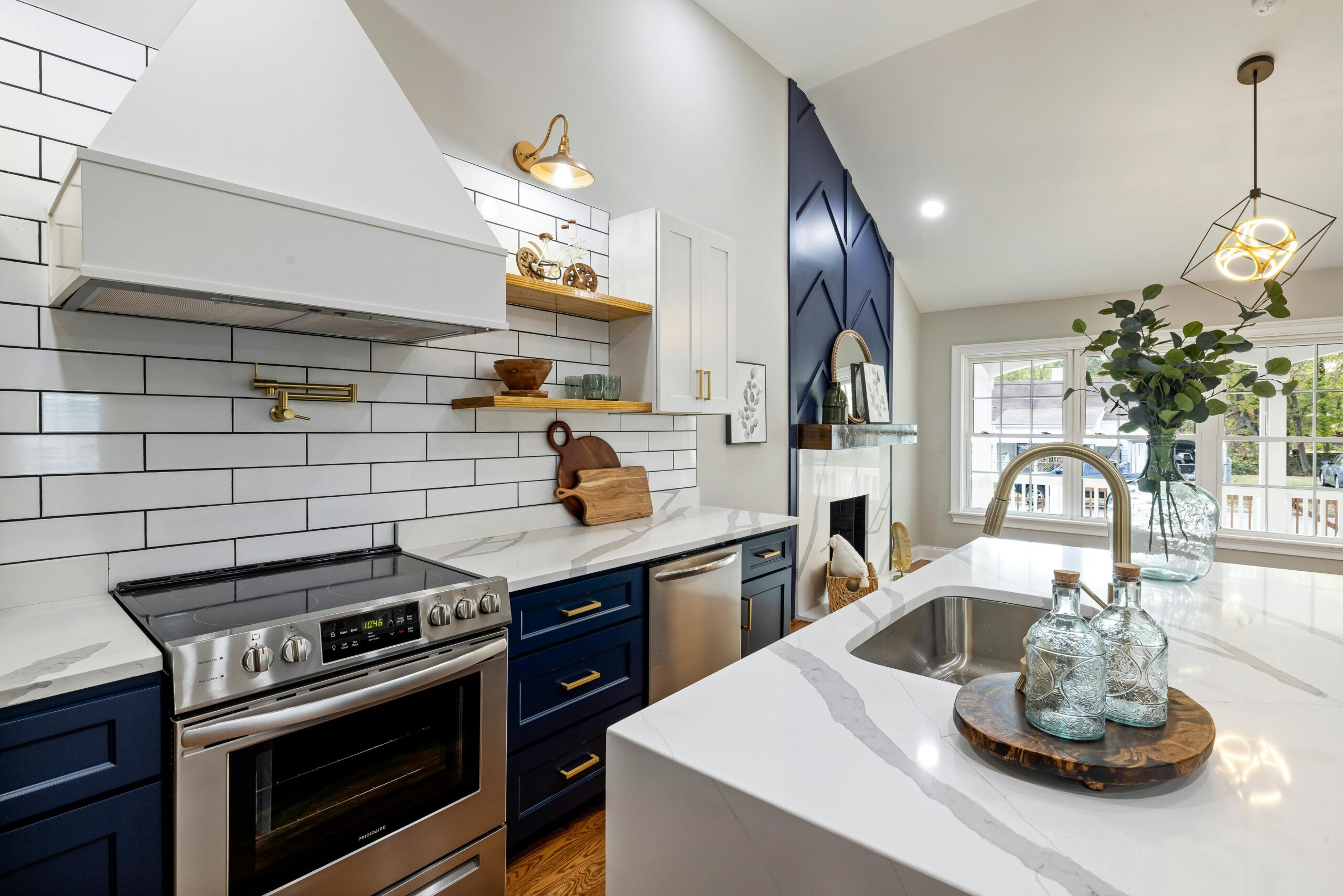
The backsplash material and pattern also affect perceived size. A backsplash tile installed from countertop to ceiling on one wall creates vertical emphasis that draws the eye upward and makes the ceiling feel higher. A horizontal pattern (like a subway tile laid in a running bond) elongates the wall visually. Both strategies cost the same as a standard backsplash but change the perception of room dimensions.
Appliance selection for small kitchens
Standard appliance dimensions assume a standard kitchen. In a compact room, downsizing one or two appliances can free up counter and cabinet space that changes how the kitchen functions. A 24-inch-wide refrigerator (counter-depth, 11 to 13 cubic feet) fits flush with standard countertops and saves 6 inches of depth compared to a full-size 30-inch model. That 6 inches returns a foot of usable aisle space in a galley kitchen where every inch of clearance matters.
A 24-inch-wide dishwasher fits where a standard 18-inch model would go, or a compact 18-inch dishwasher (holding 8 to 10 place settings versus 14 to 16 in a standard unit) saves 6 inches of cabinet width. For a household of one or two people, the smaller dishwasher handles daily loads without issue, and the freed cabinet slot can hold a pull-out recycling bin or additional drawers. These appliance choices are part of the design-build conversation at Wright’s Renovations because the appliance dimensions must be confirmed before the cabinet layout is finalized.
Range hoods in small kitchens deserve special attention. A 30-inch range under a microwave-over-range combination (the most common setup in small kitchens across the Wayne County area) provides basic ventilation but limits headroom and creates a cramped feel above the stove. Replacing the microwave-range combo with a slim range hood (6 to 8 inches deep) and mounting the microwave in a base cabinet or on a shelf opens the visual space above the stove dramatically. The range hood should vent to the exterior whenever possible; recirculating hoods in small kitchens do not remove grease and moisture effectively because the air volume is smaller and the cooking odors have nowhere to dissipate.
Color and material strategies that make 90 square feet feel like 130
Beyond the structural and layout changes, the finish materials you select in a small kitchen have an outsized impact on perceived size. Reflective surfaces bounce light and create visual depth. Glossy subway tile on the backsplash, polished quartz countertops, and satin-finish cabinet doors all contribute to a brighter room. Matte finishes absorb light, which works in large kitchens but can flatten a small one.
Glass-front cabinet doors on two or three upper cabinet positions add visual depth by letting the eye pass through the door surface into the cabinet interior. Even if the interior is simply stacked white dishes, the perceived depth of that additional 12 inches makes the wall feel less solid. For homeowners in Oakland County and the Birmingham area remodeling a secondary kitchen or a guest suite kitchenette, glass-front uppers paired with under-cabinet lighting create a display quality that transforms a 60-square-foot kitchenette to feel intentional rather than cramped.
What a small kitchen remodel costs in Southeast Michigan
A small kitchen remodel in our projects typically runs $25,000 to $50,000 for a comprehensive renovation that includes new cabinets, countertops, flooring, lighting, plumbing fixtures, and backsplash. The smaller room means less material, but the per-square-foot cost is often higher than a large kitchen because the labor, plumbing, electrical, and permitting costs are similar regardless of room size.
The kitchen remodel cost tiers article explains how material selection moves a project between budget brackets. In a small kitchen, I often recommend spending more per unit on fewer items: better cabinet quality in fewer linear feet, a higher-grade countertop on a smaller surface area, and premium fixtures that justify their cost through daily use in a room where you see and touch everything at close range.
Working with Wright’s Renovations on your small kitchen remodel
Small kitchens demand more precision in design than large ones because there is no room for error. A cabinet run that is 2 inches too long in a 300-square-foot kitchen is barely noticeable. The same 2 inches in a 90-square-foot kitchen blocks a drawer from opening fully. Our design-build process measures every dimension before designing, which prevents the fit issues that plague small kitchen renovations where the contractor measures once and discovers problems during installation.
Schedule a consultation to discuss layout and storage solutions for your compact kitchen. We work with homeowners across Washtenaw, Oakland, and Wayne counties and small kitchen remodels are some of our most satisfying projects. The constraints of a compact kitchen force creative solutions that larger rooms do not require, and the result is often a tighter, more intentional design than a kitchen with unlimited square footage. A 90-square-foot kitchen remodeled with precision outperforms a 200-square-foot kitchen designed carelessly, and that precision starts with the measurement and layout work during the design phase. These are also among the fastest projects we complete because the material quantities are smaller and the scope is contained within a single compact room. Most small kitchen remodels finish in three to four weeks from demolition day through final inspection and walkthrough because the impact is immediate and the homeowner feels the difference every day. Check our client reviews for examples of compact kitchen transformations.
