
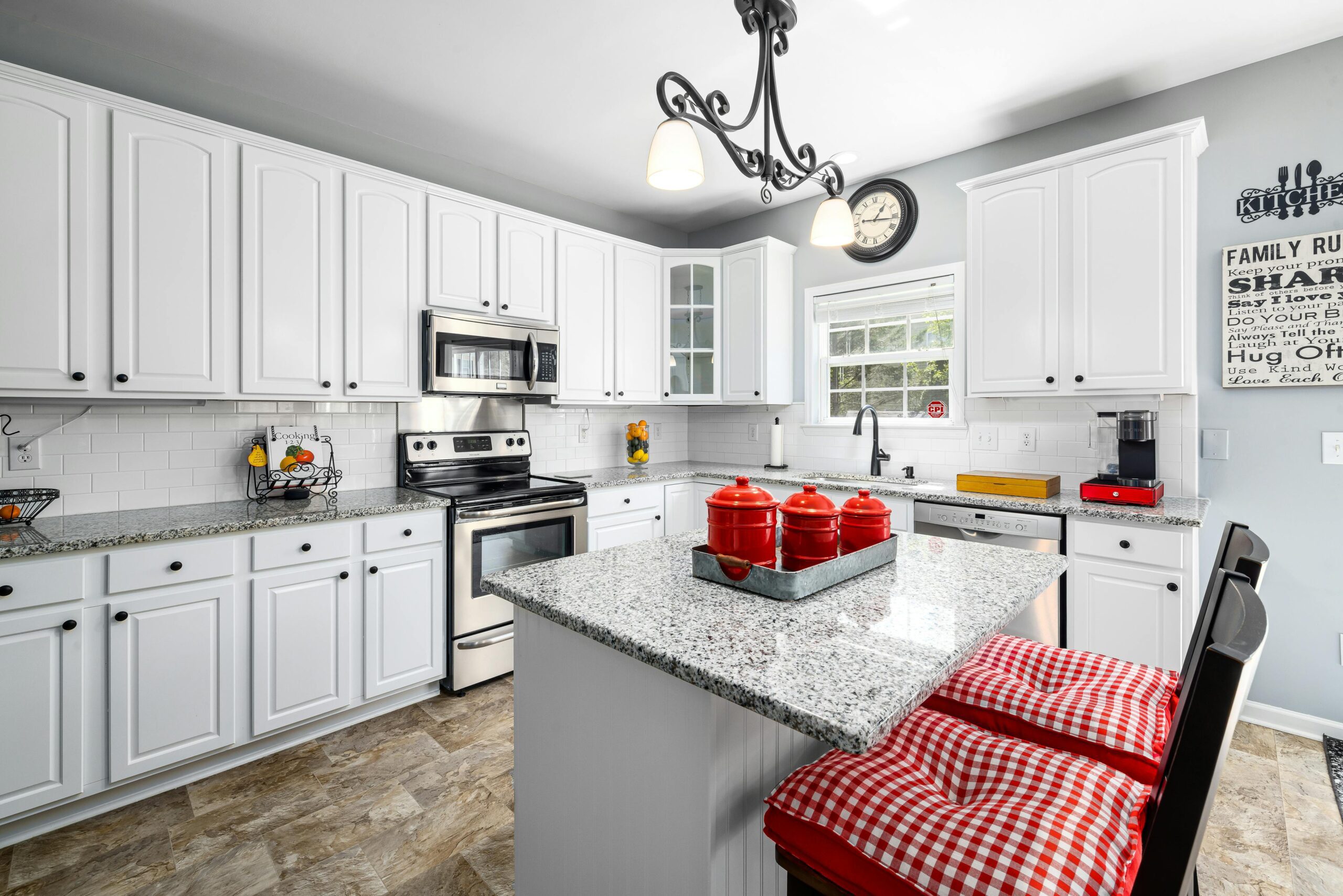
Kitchen countertop edge profiles: style and function for every budget
Table of contents
- How your countertop edge profile shapes the kitchen design
- Eased edge: the standard that works for most Michigan kitchens
- Beveled edge: a subtle upgrade with visual depth
- Bullnose and half-bullnose: rounded edges for traditional kitchens
- Ogee edge: the traditional statement profile
- Mitered edge: doubling the visual thickness without doubling the weight
- Waterfall edge: when the countertop defines the island
- Laminated edge: the mid-century and retro option
- Matching the edge to your kitchen style
- The fabrication process: what happens after you choose an edge
- Maintenance and repair considerations by edge type
- Making the edge decision at Wright’s Renovations
How your countertop edge profile shapes the kitchen design
Kitchen countertop edge profiles are the detail most homeowners overlook until the fabricator asks them to pick one. By then, the countertop slab is already selected, the cabinets are ordered, and the edge decision gets made in five minutes with a laminated card of profile drawings. That is a mistake. The edge you choose affects how the countertop looks from across the room, how comfortable it is to lean against while cooking, how easy it is to clean, and how much the fabrication adds to your kitchen remodel budget. I walk every client through edge options early in the design process because the edge is the part of the countertop you see at eye level every time you stand in the kitchen.
Eased edge: the standard that works for most Michigan kitchens
An eased edge is a flat, squared-off profile with a slight rounding (1/16 to 1/8 inch radius) on the top corner to soften the sharp 90-degree angle. It is the default edge profile at most fabricators, included in the base price with no upcharge. For homeowners in Ann Arbor and Birmingham working within the mid-range budget of a kitchen remodel cost tier, the eased edge keeps fabrication costs down without sacrificing the clean, modern look that pairs with flat-panel or shaker cabinets.
The eased edge shows the full thickness of the countertop slab, typically 1.25 inches (3 cm) for natural stone and engineered quartz. That thickness reads as substantial without being bulky. The flat face of the edge catches light cleanly, and the slight rounding on top prevents the chipping that occurs on raw sharp 90-degree corners. In our projects, the eased edge is the most common choice by a ratio of roughly three to one over any other profile.
When eased works best
Modern and contemporary kitchen designs. The eased edge is geometrically minimal, which complements kitchens with flat-panel cabinets, integrated pulls, and clean horizontal lines. It also pairs well with kitchen islands where a waterfall edge wraps down the side of the island. The eased profile keeps the transition between the horizontal surface and the vertical waterfall clean and sharp.
Beveled edge: a subtle upgrade with visual depth
A beveled edge cuts a 45-degree angle along the top edge of the countertop, creating a narrow flat surface at the top before the face drops vertically. The bevel width is typically 1/4 to 1/2 inch. This small angle catches light differently than the flat eased edge, adding a shadow line that gives the countertop more visual weight without changing the overall profile dramatically.
Fabrication cost for a beveled edge adds $5 to $10 per linear foot over the eased edge. For a kitchen with 20 linear feet of countertop perimeter, that is $100 to $200 total. The cost is minimal enough that I consider the bevel a free upgrade in terms of visual impact per dollar. It works in both traditional and modern kitchens because the profile is subtle enough to not define a specific style.
Bullnose and half-bullnose: rounded edges for traditional kitchens
A full bullnose rounds the entire top edge into a half-circle profile. A half-bullnose (also called a demi-bullnose) rounds only the top corner while keeping the face vertical. Both profiles soften the countertop edge visually and physically, which matters in kitchens where children regularly lean against the counter or where the homeowner prefers a less angular, more traditional aesthetic.
In our Southeast Michigan projects, full bullnose appears most often on granite countertops in traditional and transitional kitchens across Northville, Plymouth, and Novi. The rounded profile complements the raised-panel cabinet doors and crown molding details common in these neighborhoods. On a quartz countertop, the half-bullnose is more common because it provides the softened edge without the fully round profile that can read as dated on an engineered surface.
Cost for bullnose fabrication adds $10 to $20 per linear foot. A 20-linear-foot kitchen adds $200 to $400 for the edge upgrade. The shaping requires more grinding passes than a simple bevel, which explains the price difference.
Ogee edge: the traditional statement profile
The ogee edge combines a concave curve at the top with a convex curve below, creating an S-shaped profile that has been a hallmark of traditional kitchen design for decades. It adds visual richness and weight to the countertop, making the slab look thicker and more substantial than its actual 1.25-inch dimension. In granite and marble, the ogee profile reveals the stone’s mineral patterns along the curved face, which adds another layer of visual interest.
Ogee fabrication costs $15 to $30 per linear foot, making it one of the more expensive standard profiles. For a 20-linear-foot kitchen, expect $300 to $600 added to the countertop fabrication cost. The ogee is a deliberate design choice, not a default, and it looks best in kitchens with traditional or ornate cabinetry. Pairing an ogee edge with minimalist flat-panel cabinets creates a visual conflict between the ornamental edge and the simple door faces. I steer clients away from that combination.
Mitered edge: doubling the visual thickness without doubling the weight
A mitered edge joins two pieces of countertop material at a 45-degree angle to create the appearance of a thicker slab. A standard 1.25-inch (3 cm) countertop with a mitered edge looks 2.5 inches (6 cm) thick, and a 2-cm slab mitered to itself appears 4 cm thick. The seam between the two pieces, when properly fabricated, is nearly invisible.
This profile is the go-to for waterfall islands, where the countertop wraps over the edge of the island and continues vertically to the floor. The mitered joint at the corner determines the quality of the waterfall. A poorly mitered waterfall shows a visible seam line, color mismatch between the horizontal and vertical surfaces, or a slight misalignment in the pattern. A well-fabricated miter is invisible from normal viewing distance, and the pattern on the slab flows continuously around the corner.
Mitered edge costs and considerations
Mitering is the most expensive standard edge treatment, adding $30 to $60 per linear foot. For a waterfall island with two waterfall sides (4 linear feet of mitered edge per side, 8 feet total), the miter adds $240 to $480 to the fabrication cost. The expense is justified by the visual impact. A waterfall island with a well-executed miter is the single most dramatic element in a modern kitchen design, and it is the feature that photographs best for resale listings.
Not all materials miter well. Quartz miters cleanly because the engineered material is uniform through its thickness. Natural stones with strong directional veining require the fabricator to book-match the slab so the vein pattern continues around the corner. Book-matching adds cost ($100 to $300 for the extra slab coordination and cutting waste) but produces a result that no other technique achieves.

Waterfall edge: when the countertop defines the island
A waterfall edge extends the countertop material from the horizontal work surface down the side of the island to the floor. It is not technically an edge profile but rather a countertop application that uses a mitered edge at the transition point. I include it here because the waterfall decision is inseparable from the edge profile conversation.
In our Oakland County kitchen projects and Washtenaw County renovations, waterfall islands account for roughly 40 percent of island installations. The material cost for the waterfall panel itself is simple math: the vertical surface uses the same slab as the horizontal, and the fabricator cuts both from the same piece. A single-side waterfall on a 36-inch-tall, 48-inch-wide island requires approximately 12 square feet of additional slab material. At $80 per square foot for quartz, that is $960 in additional material plus $200 to $400 for the mitered fabrication.
Double-waterfall islands (material cascading down both ends) cost roughly twice the additional material and fabrication, but the visual impact in an open-concept kitchen is substantial. The island becomes a sculptural object rather than a functional box, and it anchors the kitchen in layouts where the pendant lighting and seating arrangement orbit around the island as the room’s focal point.
Laminated edge: the mid-century and retro option
Laminate countertop edges use a built-up wood substrate covered with the same laminate material as the top surface. Post-formed laminate rolls the surface material around a bullnose-shaped edge in one continuous piece, eliminating a visible seam. Self-edge laminate applies a separate strip of matching laminate to the exposed edge, creating a thin visible line where the top surface meets the edge piece.
Laminate countertops and their associated edge profiles sit in the $20 to $45 per square foot installed range, making them the most affordable countertop option by a significant margin. For a budget kitchen remodel in Wayne County or Canton where the total kitchen budget is under $20,000, laminate with a post-formed edge delivers a clean look at a price point that leaves room in the budget for better flooring or cabinetry.
Matching the edge to your kitchen style
The edge profile should match the design vocabulary of the rest of the kitchen. Here is how I approach the recommendation based on the cabinets and overall direction a homeowner has chosen.
- Modern or contemporary cabinets (flat panel, slab doors, integrated pulls): Eased edge or mitered edge. The clean geometry of these edges complements the linear design language. Avoid ogee or bullnose, which add curves that conflict with the flat cabinet faces.
- Traditional cabinets (raised panel, ornate hardware, crown molding): Ogee, bullnose, or half-bullnose. The curved profiles echo the curves in the door panels and the hardware. An eased edge on a traditional kitchen can look unfinished.
- Transitional cabinets (shaker doors, simple hardware, a mix of traditional and modern): Beveled edge or half-bullnose. These profiles add subtle detail without committing to either extreme. The bevel is modern-leaning; the half-bullnose is traditional-leaning.
- Farmhouse or cottage style (open shelving, apron-front sinks, wood accents): Full bullnose or honed surface with an eased edge. The rounded edge softens the countertop, and a honed (matte) finish on the surface echoes the unfussy aesthetic of the style.
The fabrication process: what happens after you choose an edge
Understanding the fabrication process helps explain why edge profiles cost what they cost and why some profiles are riskier than others on certain materials. After you select a slab and approve the edge profile, the fabricator templates your kitchen by creating a precise physical or laser-mapped outline of every countertop section. The template captures exact measurements, cutout locations for sinks and faucets, and the edge dimensions for every exposed side.
The slab is then cut on a CNC (computer numerical control) bridge saw that follows the template data. Edge shaping happens either on the CNC or on a separate edge profiling machine that uses diamond-impregnated wheels to grind the desired shape. Simple profiles like eased and beveled require one or two passes. Complex profiles like ogee require four to six passes with progressively finer wheels. Mitered edges require cutting two pieces at precisely matching 45-degree angles, then bonding them with color-matched adhesive and clamping until cured. The more passes and the tighter the tolerances, the higher the labor cost.
Maintenance and repair considerations by edge type
The edge profile you select affects long-term maintenance because different shapes are more or less prone to chipping, and chips on complex profiles are harder to repair. An eased edge chip is a clean break that a fabricator can fill and polish in most cases. An ogee chip removes material from a curved surface that requires reshaping, which is more labor-intensive and sometimes impossible to match perfectly. Beveled edges fall in between: the flat bevel surface chips cleanly, but the transition between the bevel and the face can fracture irregularly.
For kitchens with heavy daily use, particularly those where cast iron pans, ceramic dishes, and heavy mixer bowls regularly contact the counter edge, I recommend staying with eased or beveled profiles. The best protection against future chips is choosing a profile that survives daily kitchen life without requiring unusual care.
Rounded profiles (bullnose and half-bullnose) are actually the most chip-resistant because there is no sharp corner to catch impact. The curved surface deflects force rather than concentrating it at a point. For families with children who lean on counters, bump into edges, and place objects carelessly, a half-bullnose combines traditional aesthetics with practical durability that eased and beveled edges cannot match.
Making the edge decision at Wright’s Renovations
Every design-build consultation at Wright’s Renovations includes edge profile selection as part of the countertop conversation. We bring physical edge profile samples in the material you are considering so you can see and feel each option. Looking at a profile drawing is different from running your hand along the actual edge. The ogee feels ornate in a way the drawing does not communicate. The mitered edge looks thicker than you expect from a cross-section diagram.
We also show you how each edge profile interacts with your specific cabinet door style by placing the edge sample against the cabinet sample. That side-by-side comparison takes 30 seconds and prevents a mismatch that would live in the kitchen for decades.
Schedule your consultation to compare edge profiles on real material samples. We serve kitchen remodel clients across Washtenaw County, Oakland County, the Wayne County communities, and the surrounding areas. Check our client reviews to see how edge profiles look in completed Michigan kitchen remodels.
