
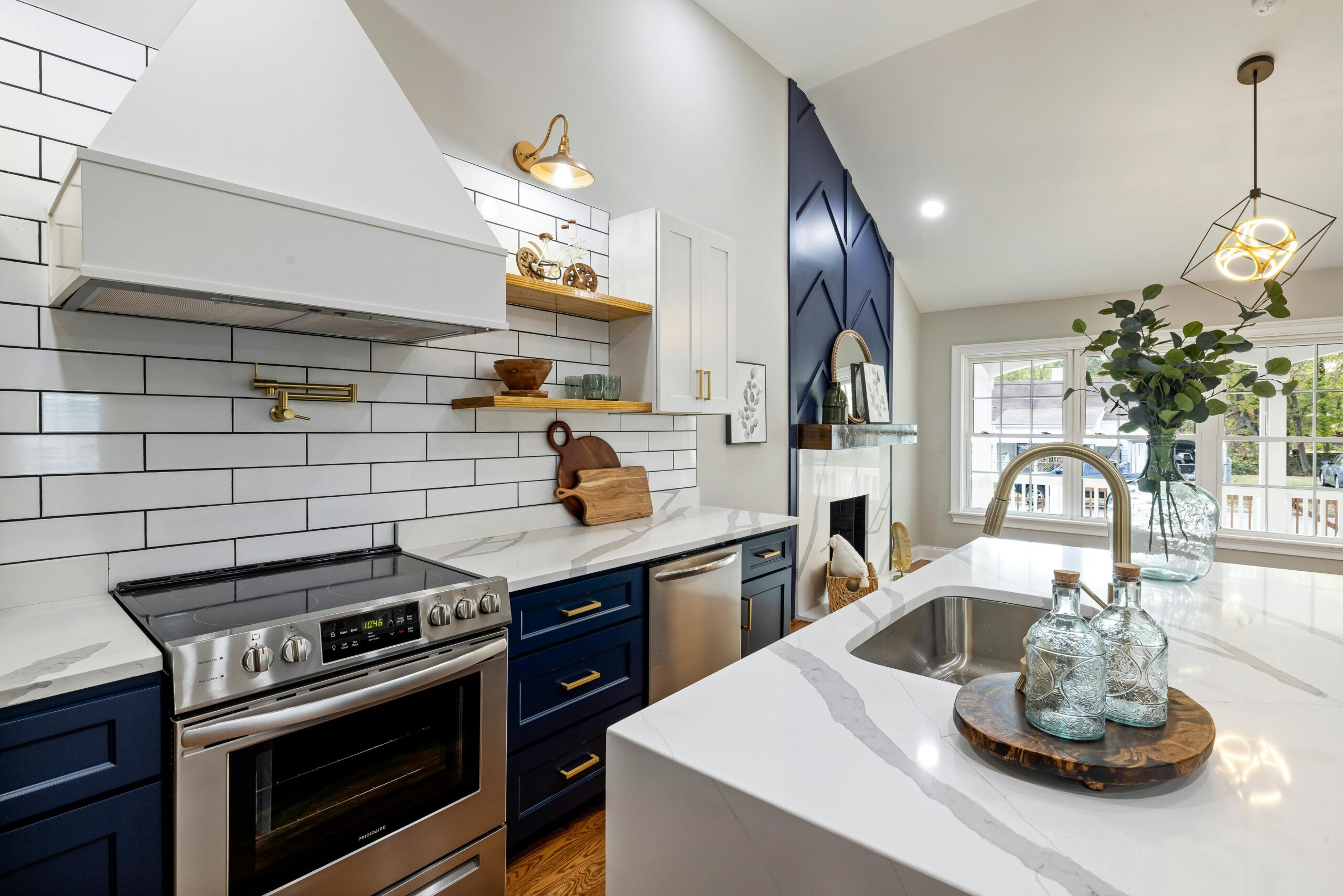
Kitchen cabinets: stock vs. semi-custom vs. custom in Michigan
Table of contents
- What separates stock, semi-custom, and custom kitchen cabinets
- Stock cabinets: the fastest path to a finished kitchen
- Semi-custom cabinets: the middle ground most Michigan homeowners land on
- Custom cabinets: built from scratch for your specific kitchen
- Side-by-side comparison: what matters for your Michigan kitchen
- How to decide: questions I ask every client
- Michigan-specific considerations for cabinet selection
- What I would do with my own kitchen budget
- Working with Wright’s Renovations on your cabinet decision
What separates stock, semi-custom, and custom kitchen cabinets
Choosing kitchen cabinets stock vs. custom is the single decision that shapes the rest of your remodel. Cabinets account for roughly 35 to 40 percent of a typical kitchen remodel budget in Southeast Michigan, and the tier you pick determines your layout flexibility, material options, finish quality, and how long you wait before installation day. I have installed thousands of cabinet boxes across Washtenaw, Wayne, and Oakland counties, and the differences between tiers are not subtle once you know what to look for.
This guide walks through all three tiers with the pricing, lead times, and construction details we actually see on Michigan job sites. No sales pitch for one tier over another. The right cabinet depends on the room, the budget, and how long you plan to stay in the house.
Stock cabinets: the fastest path to a finished kitchen
Stock cabinets are pre-manufactured in fixed sizes and finishes. A distributor warehouses them locally, and a contractor can usually have boxes on site within one to two weeks of ordering. For homeowners in Canton, Livonia, or anywhere a quick turnaround matters, stock cabinets remove the longest variable from the project timeline.
How stock cabinets are built
Most stock lines use particleboard or medium-density fiberboard (MDF) for the cabinet box. Doors are typically thermofoil-wrapped MDF or a basic hardwood veneer in three to five stain options. Drawer boxes are usually stapled melamine, and hinges are the concealed European type but at the lower end of the hardware spectrum. You will not find dovetail drawer joints or plywood box construction at this tier, and that is the tradeoff for the price point.
Standard widths come in 3-inch increments: 12, 15, 18, 21, 24, 27, 30, 33, and 36 inches for base cabinets. If your kitchen wall measures 127 inches, you fill the gap with filler strips. Those filler strips are noticeable to anyone who looks, and they limit where you can place a kitchen island relative to the perimeter cabinets.
What stock cabinets cost in Michigan
For a typical 10-by-10-foot L-shaped kitchen, stock cabinets run $4,000 to $8,000 installed. That number covers boxes, doors, drawer fronts, hinges, basic crown molding, and labor. It does not cover countertops, backsplash, plumbing fixtures, or lighting upgrades. In our Southeast Michigan projects, stock cabinets appear most often in rental properties, investment flips, and budget-conscious first-time homeowner remodels where keeping total project cost under $35,000 is the priority.
When stock cabinets make sense
- Budget is the primary constraint. If you need functional, decent-looking cabinets and every dollar matters, stock delivers. A $6,000 cabinet package frees up budget for better countertops or appliances.
- Speed matters more than customization. Stock cabinets can arrive in days. A full kitchen remodel with stock cabinets can finish three to four weeks faster than one waiting on custom boxes.
- The layout is standard and the kitchen footprint does not need to change. If you are keeping the same sink location, same appliance positions, and same basic L or U shape, stock sizes often fit without excessive filler.
Semi-custom cabinets: the middle ground most Michigan homeowners land on
Semi-custom cabinets start with a manufacturer’s standard product line but allow you to modify dimensions, finishes, door styles, and interior accessories. Think of them as stock cabinets with an options sheet. The base price is higher, but the flexibility eliminates most of the compromises that come with fixed sizes and limited finishes. In the projects we build across Ann Arbor, Plymouth, and Northville, semi-custom is the most common choice by a wide margin.
What semi-custom actually means
The modifications available at the semi-custom tier vary by manufacturer, but the common options include width adjustments in 1-inch increments (not just 3-inch), depth modifications for shallow pantries or appliance garages, door style selection from 30 to 80 profiles, finish and stain choices across 20 to 50 colors, soft-close hinges and drawer slides as standard, plywood box construction (rather than particleboard), and dovetail drawer boxes on higher-end lines.
The construction quality jump from stock to semi-custom is significant. Where a stock drawer box uses stapled melamine that may loosen after five years of daily use, a semi-custom drawer uses solid wood with dovetail joints that will outlast the house. The door panels are thicker, the finish coats are more durable, and the hinges carry a lifetime warranty from most major manufacturers.
Semi-custom cabinet costs in Michigan
For the same 10-by-10 L-shaped kitchen, semi-custom cabinets typically run $12,000 to $25,000 installed. The range is wide because a basic semi-custom order with minimal modifications costs far less than one with custom paint colors, glass inserts, specialty pullouts, and integrated pantry systems. Our average semi-custom cabinet order in Washtenaw County lands around $16,000 to $18,000 for a mid-size kitchen, which includes soft-close everything, a mix of shaker and flat-panel doors, and two or three interior accessories like lazy Susans or pull-out trash bins.
Lead times for semi-custom
Expect four to eight weeks from order to delivery. Some manufacturers run faster; painted finishes and specialty door styles push toward the longer end. This is the biggest operational difference between stock and semi-custom. A well-planned renovation process accounts for this lead time by ordering cabinets during the design phase, before demolition begins. When we sequence a project correctly, the cabinets arrive the same week demolition wraps, and the crew moves straight into installation with zero downtime.
Custom cabinets: built from scratch for your specific kitchen
Custom cabinets are manufactured to your exact specifications by a cabinet shop. There are no standard sizes, no options sheets, no constraints from a product catalog. The cabinet maker builds every box, door, and drawer to the dimensions your kitchen requires, using the species, finish, and joinery methods you select. For the historic homes in Birmingham and the large-footprint kitchens in Novi, custom cabinets solve problems that no catalog product can address.
When custom cabinets are worth the investment
I recommend custom cabinets in specific situations, not as a default premium upsell. The scenarios where custom makes sense include kitchens with non-standard ceiling heights where you want cabinets that extend to the ceiling without a filler or soffit, historic homes where the cabinet face frames need to match existing millwork profiles, unusually shaped rooms where angled walls, support columns, or bay windows make standard sizing impossible, and homeowners who want a specific wood species like rift-cut white oak or quarter-sawn walnut that semi-custom lines do not carry.
If your kitchen has standard 8-foot or 9-foot ceilings, a rectangular or L-shaped footprint, and you are happy with one of the 40-plus door styles available in a good semi-custom line, custom cabinets will cost you 40 to 100 percent more without a proportional improvement in function or appearance. I tell clients this directly because the money saved on custom cabinets can fund better appliances, a premium surface material, or a larger island.
Custom cabinet costs in Michigan
Custom cabinets for a 10-by-10 kitchen typically start at $25,000 and can reach $60,000 or more depending on species, finish complexity, and the shop producing them. A local Michigan cabinet shop with a strong reputation will quote differently than a high-end national shop that ships from the East Coast. Our projects that include custom cabinets average between $30,000 and $45,000 for the cabinet package alone, with total kitchen remodel costs ranging from $80,000 to $150,000 when countertops, appliances, plumbing, electrical, and finishes are included.
Lead times for custom
Eight to sixteen weeks is standard. Complex projects with hand-applied finishes, curved elements, or extensive glass work can push beyond twenty weeks. This is the single biggest planning consideration with custom cabinets. A homeowner who decides on custom in February should expect delivery no earlier than May, which means the kitchen is out of service through spring if demolition happens before the cabinets arrive. We strongly recommend completing the design-build process and ordering cabinets months before the target construction start date.

Side-by-side comparison: what matters for your Michigan kitchen
Here is how the three tiers compare on the factors that actually determine which cabinet you should buy. I have seen homeowners overspend on custom cabinets they did not need and underspend on stock cabinets that started falling apart within three years. The goal is matching the tier to the project.
- Box construction: Stock uses particleboard or MDF. Semi-custom typically offers plywood. Custom uses whatever you specify, usually 3/4-inch plywood or solid hardwood.
- Drawer quality: Stock uses stapled melamine. Semi-custom offers dovetail hardwood. Custom builds drawers from the same species as the face frames.
- Finish durability: Stock applies one to two coats of lacquer or thermofoil wrap. Semi-custom applies three to four catalyzed coats. Custom applies five or more coats with hand sanding between each layer.
- Sizing flexibility: Stock works in 3-inch increments. Semi-custom adjusts in 1-inch increments. Custom builds to the exact millimeter.
How to decide: questions I ask every client
When a homeowner sits down with me to plan a kitchen renovation, I walk through a short list of questions that usually points clearly to one tier. The answers matter more than the budget alone, because I have seen $150,000 kitchen projects that correctly used semi-custom cabinets and $50,000 projects where custom was the right call due to the room geometry.
First, how long do you plan to live in this house? If you are staying ten-plus years, investing in semi-custom or custom pays back in daily satisfaction and durability. If you are selling within three to five years, stock or entry-level semi-custom captures most of the visual appeal buyers notice without overcapitalizing.
Second, does your kitchen have any non-standard dimensions? Measure the ceiling height, the distance between windows, the depth of any soffits, and the angles of any walls. If everything falls within standard ranges, semi-custom handles it. If the room has quirks, custom may be the only way to avoid visible fillers and awkward gaps.
Third, do you have a specific door style or wood species in mind? If you want painted shaker doors in white, gray, or navy, every semi-custom manufacturer offers that. If you want rift-sawn white oak with a clear matte finish and integrated finger pulls instead of hardware, that is a custom job.
Fourth, what is your timeline? If you need the kitchen finished before a holiday, family event, or school year, lead times dictate the tier. A stock order ships in one to two weeks. Semi-custom needs six weeks minimum. Custom needs twelve or more. I have had clients switch from custom to semi-custom after realizing the lead time pushed completion past Thanksgiving, and they were happy with the result because the semi-custom line had everything they actually needed.
Michigan-specific considerations for cabinet selection
Southeast Michigan homes have characteristics that affect cabinet performance in ways that matter over decades. The humidity swings between a dry 15 percent in January and a humid 75 percent in August stress wood differently than homes in drier climates. Solid wood doors expand and contract with those swings. A well-built cabinet accounts for this movement with floating center panels and properly sealed end grain. Cheaper stock cabinets with thermofoil wraps can delaminate after several Michigan winters if the kitchen is not consistently climate-controlled.
Older homes in older Ann Arbor neighborhoods and Ypsilanti frequently have plaster walls that are not perfectly plumb or level. Installing stock cabinets in a room where the walls are 3/8 inch out of plumb over 8 feet requires shimming, scribing, and sometimes cutting filler pieces that eat into the clean look the homeowner expected. Semi-custom and custom cabinets handle this better because the boxes can be sized to account for the room’s actual measurements, not the theoretical measurements of a blueprint.
The local cabinet shop ecosystem matters too. Southeast Michigan has several respected custom cabinet shops that build locally. Buying custom from a local shop means your designer can visit the shop floor, inspect samples of the actual materials going into your kitchen, and resolve finish questions face-to-face. That level of access does not exist when ordering from a national manufacturer, even at the custom tier.
What I would do with my own kitchen budget
If I were remodeling my own kitchen on a $40,000 total budget, I would put $14,000 into a mid-range semi-custom cabinet line with plywood boxes, dovetail drawers, soft-close hinges, and painted shaker doors. That leaves $26,000 for quartz or granite surfaces, a quality sink and faucet, new flooring, updated lighting, backsplash, and the labor to demo and rebuild. The cabinets would look and perform identically to a $30,000 custom set in a kitchen with standard dimensions, and the money saved would go into the surfaces and fixtures I touch every day.
If my budget were $100,000 and the kitchen had 10-foot ceilings with a curved bay window eating into the cabinet run, I would go custom without hesitating. The geometry demands it, and the budget supports it.
If I were flipping a house in Wayne County and needed the kitchen to photograph well for the listing, I would use stock cabinets in a clean white shaker profile, spend $5,500 on the boxes, and put the rest into quality quartz work surfaces and stainless appliances. Buyers notice the countertops and the appliances. They open one or two cabinet doors. Stock passes that test at a fraction of the cost.
Working with Wright’s Renovations on your cabinet decision
Every kitchen project starts with a consultation where we measure the room, discuss how you cook and use the space, and talk honestly about budget. I show physical samples from the semi-custom lines we install most often and bring catalog options for custom work so you can compare materials side by side. There is no pressure toward any tier. The right cabinet is the one that fits your room, your habits, and your budget for the next ten years.
If you want to see what different cabinet tiers look like installed in real Michigan homes, check our client reviews or schedule a consultation to walk through your options in person. We serve homeowners across Washtenaw County, Oakland County, and the Wayne County communities, and cabinet selection is one of the conversations I look forward to most because it shapes everything else in the kitchen.
