
Kitchen cabinet colors: how to choose a finish that lasts
Table of contents
- Choosing kitchen cabinet colors that hold up for a decade
- White cabinets: the default that works for a reason
- Gray cabinets: the mid-2010s trend with uneven staying power
- Navy and dark blue: bold but polarizing
- Green cabinets: the current trend with historical roots
- Natural wood and stained cabinets: the return of warmth
- Two-tone cabinets: upper and lower in different colors
- Hardware color and cabinet color interaction
- Paint finish types and their impact on durability
- How to test cabinet colors before committing
- Making the color decision with Wright’s Renovations
Choosing kitchen cabinet colors that hold up for a decade
Kitchen cabinet colors set the mood of the room before you notice anything else. The cabinets are the largest visual surface in most kitchens, covering 30 to 60 square feet of wall space depending on the layout. The color you choose either dates the kitchen in five years or keeps it current for fifteen. I have painted, stained, and refinished thousands of cabinet doors across Southeast Michigan, and the patterns are clear: some colors age gracefully and some become the thing the next homeowner rips out first.
This guide covers the painted and stained cabinet finishes we install most often, the cost difference between color options, and the honest assessment of which trends have staying power versus which ones are already fading in the Ann Arbor, Birmingham, and broader Southeast Michigan markets.
White cabinets: the default that works for a reason
White kitchen cabinets dominate our project portfolio and the broader renovation market for practical, not just aesthetic, reasons. White reflects light, making kitchens feel larger and brighter. White pairs with every countertop material, every backsplash color, and every flooring option. White does not clash with the existing trim, doors, or adjacent room colors in your home. And white is the safest choice for resale because no buyer looks at white cabinets and thinks they need to be replaced.
The variety within white is larger than most homeowners realize. A bright, blue-undertone white (like Benjamin Moore Chantilly Lace) reads as crisp and modern. A warm, yellow-undertone white (like BM White Dove or Simply White) reads as soft and traditional. A gray-undertone white (like BM Pale Oak or Revere Pewter at the lightest application) bridges contemporary and transitional styles. The undertone you choose must match the countertop and lighting color temperature in the room, or the cabinets will look dirty, pink, or green depending on the interaction.
White cabinet costs and maintenance
White painted cabinets cost 10 to 20 percent more than stained cabinets in the same door style because painted finishes require more coats, more sanding between coats, and tighter quality control. A fingerprint, a drip, or an uneven coat is invisible on a medium-stain wood door but glaring on a white painted surface. In our semi-custom orders, the painted white upcharge is typically $1,500 to $3,000 on a mid-size kitchen. Custom cabinet shops charge a similar premium because the labor per door is higher for paint than for stain.
White cabinets show dirt, grease, and fingerprints more readily than darker colors. Doors around the stove, the sink, and the dishwasher handle zone need wiping weekly to stay clean. This is not a durability issue; the paint finish on a quality cabinet is catalyzed and resists staining from normal kitchen substances. It is a visibility issue. Every smudge is visible on a white surface that would be invisible on a gray or wood-tone door.
Gray cabinets: the mid-2010s trend with uneven staying power
Gray kitchen cabinets peaked around 2016 to 2019 and remain common in our project consultations, but the trend has shifted toward warmer tones. A cool gray (blue-undertone) cabinet that looked current in 2017 reads as dated in 2026 when paired with the warm-toned countertops, brass hardware, and natural wood accents that define the current moment. A warm gray (greige, essentially gray with brown or taupe undertones) has more longevity because it bridges cool and warm palettes without committing to either extreme.
If you are considering gray cabinets, I recommend the warmest gray you can tolerate. Colors like Benjamin Moore Revere Pewter, Edgecomb Gray, or Balboa Mist read as gray in cool light and greige in warm light, which gives them versatility across changing trends. A true cool gray like BM Stonington Gray or Coventry Gray has a narrower window of relevance and may feel cold in Michigan kitchens during the long gray winters when warm interiors matter most.
Navy and dark blue: bold but polarizing
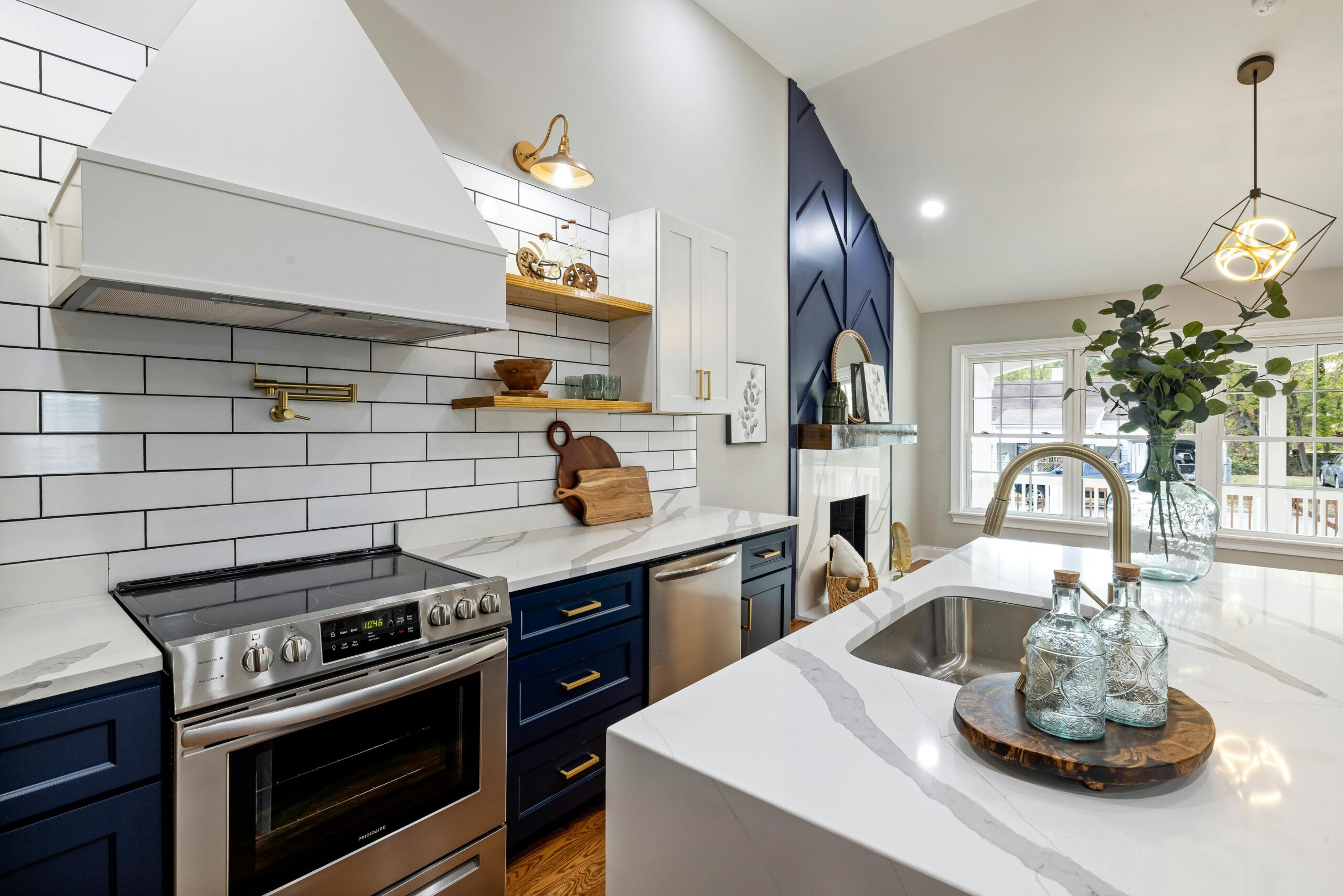
Navy cabinets make a strong design statement, particularly on lower cabinets paired with white or light wood upper cabinets (the two-tone approach). In our Plymouth and Northville projects, navy lower cabinets with brass hardware and a white quartz countertop create a high-end look that photographs exceptionally well. The color reads as sophisticated without being trendy the way gray became trendy.
The risk with navy is lighting. In a kitchen with limited natural light, navy cabinets darken the room noticeably. Under-cabinet LED lighting and adequate recessed ceiling cans are essential to prevent the lower half of the kitchen from feeling like a cave. In kitchens with north-facing windows (common in Michigan where the north side of the house gets minimal direct sunlight), navy on all cabinets can make the room feel oppressive. The two-tone approach (navy lowers, white uppers) mitigates this by keeping the upper visual field bright while grounding the room with color below.
Green cabinets: the current trend with historical roots
Green kitchen cabinets are the current trend leader in our consultations, overtaking gray in frequency of requests starting around 2023. Sage green, hunter green, and olive green appear in design publications frequently, and the color has legitimate staying power because green has appeared in kitchen design cyclically for over a century. Victorian kitchens used deep hunter green. 1950s kitchens used mint green. The current preference for sage and olive sits between those extremes.
The longevity question depends on the specific shade. A muted sage green (like BM Cushing Green or Saybrook Sage) is subtle enough to age gracefully because it reads as a neutral in many lighting conditions. A saturated emerald or forest green is a stronger commitment that may feel dated in five to seven years. If you are drawn to green, I recommend testing the specific shade in your kitchen under both natural daylight and evening artificial light before committing. The color shifts dramatically between those two conditions, and the shift matters in a room you use morning and night.

Natural wood and stained cabinets: the return of warmth
After a decade of painted cabinets dominating the market, natural wood is returning. White oak with a clear or light natural finish has become the premium cabinet material in homes across Oakland County and Washtenaw County. The wood grain is visible, the finish is matte or satin (not the high-gloss honey oak of the 1990s), and the effect is warm without feeling dated. Rift-cut white oak, which has a straight, linear grain pattern, reads as contemporary. Plain-sawn oak, which has the cathedral grain arches, reads as traditional.
Stained cabinets cost less than painted because the finishing process is simpler: fewer coats, less sanding, and the wood grain hides minor imperfections that would be visible under paint. A mid-stain on maple or cherry typically runs $1,000 to $2,000 less than the same door in a painted finish for a full kitchen. For homeowners in Canton and Livonia working within a tighter budget, a quality wood stain on a good door style delivers a premium look at a lower cost than paint.
Two-tone cabinets: upper and lower in different colors
Two-tone kitchen cabinets use one color on the upper cabinets (typically white or a light natural wood) and a different color on the lowers (navy, sage, charcoal, or a darker wood stain). The approach creates visual weight at the base of the kitchen while keeping the upper visual field open and bright. A kitchen island in a third color or a natural wood adds another layer of depth.
The cost impact of two-tone is minimal. The cabinet order includes two paint or stain specifications instead of one, which adds $200 to $500 for the additional setup at the factory. The design impact is substantial. Two-tone kitchens feel curated and intentional in a way that single-color kitchens do not, and the approach is flexible enough to work in traditional, transitional, and contemporary styles.
The pairing must be deliberate. The two colors need to share an undertone family (both warm, both cool, or one neutral bridging both). A cool blue-white upper with a warm brown lower creates a visual disconnect that makes the kitchen feel like two rooms collided. I bring paint chips and door samples together during the design consultation so the pairing is evaluated in person, not chosen from separate catalog pages.
Hardware color and cabinet color interaction
Cabinet hardware (knobs, pulls, hinges) interacts with the cabinet color in ways that change the overall kitchen mood. Brass or gold hardware on white cabinets creates a warm, collected look that reads as intentional and slightly traditional. Matte black hardware on white cabinets creates a high-contrast, contemporary graphic quality. Brushed nickel or stainless on white reads as clean and neutral, which is the safest choice if you are unsure about hardware commitment.
On dark cabinets (navy, charcoal, hunter green), brass hardware creates a rich, library-like warmth. Matte black disappears against dark surfaces, which can look sleek but eliminates the visual punctuation that hardware provides. Chrome or polished nickel on dark cabinets creates the strongest contrast and the most modern feel. I bring hardware samples to every consultation alongside the cabinet door samples because the combination matters more than either element in isolation.
For natural wood cabinets, hardware color should complement the wood’s undertone. Warm-toned woods (cherry, walnut, warm-stained oak) pair with brass and bronze. Cool-toned woods (gray-stained oak, wire-brushed ash) pair with chrome, nickel, and matte black. The goal is harmony between the metal finish and the wood’s natural color, not a match. A brass pull on walnut cabinets creates a cohesive warmth. A chrome pull on walnut creates a contrast that can work in contemporary settings but requires confidence in the mix.
Paint finish types and their impact on durability
The sheen level of cabinet paint affects both the appearance and the cleanability. Most cabinet painters use one of three finishes: satin (the most common), semi-gloss, or matte. Satin provides a soft luster that hides minor imperfections while offering reasonable wipability. Semi-gloss is shinier, shows fingerprints more readily, but cleans more easily because the smoother surface does not grip dirt. Matte finish is the current trend, delivering a soft, furniture-like appearance, but it marks more easily and requires gentler cleaning methods.
For kitchens in Macomb County and Livingston County with active households (children, pets, frequent cooking), I recommend satin or semi-gloss because the surfaces around the stove, sink, and dishwasher handle zone need weekly wiping. Matte paint in those high-touch zones will show wear patterns within two to three years. On upper cabinets that rarely get touched, matte is fine and looks beautiful. The hybrid approach (satin on base cabinets and around appliances, matte on uppers and island) gives the best of both worlds.
Catalyzed lacquer and conversion varnish finishes (applied by professional cabinet painters and factory finish lines) outperform standard latex or alkyd paints by a significant margin. These finishes cure to a harder, more chemically resistant surface that handles daily kitchen abuse without yellowing, chipping, or wearing through. The cost premium for a catalyzed finish versus standard paint is $500 to $1,200 for a full kitchen, and the longevity difference justifies the investment for anyone keeping the cabinets longer than five years. Ask your cabinet supplier whether the factory finish is catalyzed; if not, a professional painter can apply a catalyzed topcoat after delivery for similar protection.
How to test cabinet colors before committing
Paint samples on the wall are essential but not sufficient. The cabinet door is not flat drywall; it has raised or recessed panels, edge profiles, and a surface texture that changes how color appears. Request a painted sample door from the cabinet manufacturer (most semi-custom lines provide this for $50 to $100) and evaluate it inside the kitchen under both natural and artificial light.
Hold the sample door against your countertop sample, your flooring sample, and your backsplash tile. The door color that looked perfect in isolation may clash when it sits next to the warm veining of a quartzite countertop or the cool gray of a porcelain floor. Every material in the kitchen interacts with every other material. Evaluating them together prevents a mismatch you would live with for years.
Making the color decision with Wright’s Renovations
Cabinet color selection is part of every kitchen remodel consultation at Wright’s Renovations. We bring painted and stained door samples from the cabinet lines we install, hold them against your existing finishes, and photograph the combinations under your kitchen’s lighting. The in-home evaluation is more accurate than any showroom visit because showrooms use controlled lighting that does not match your space.
If you are drawn to a trend color (sage green, dark navy, charcoal), we show you how to incorporate it in a way that can be updated later without replacing the entire kitchen. Using the trend color on a standalone island cabinet while keeping perimeter cabinets in a timeless white lets you repaint the island in a weekend when the trend shifts, rather than refinishing every door in the room.
Schedule a consultation to explore cabinet color options for your kitchen remodel. We serve homeowners across the Ann Arbor area, Birmingham and Oakland County, Novi, and the surrounding communities. Check our client reviews to see how different cabinet colors look in completed Michigan kitchens.
